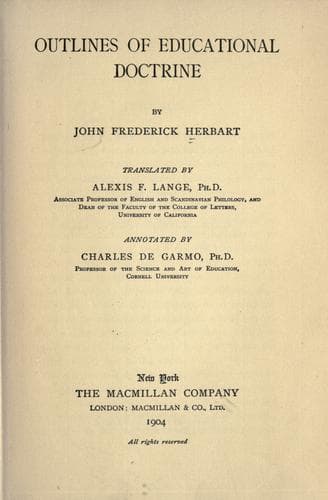
Outlines of Educational DoctrineHerbart, Johann Friedrich
Philosophy
Outlines of Educational Doctrine
Herbart, Johann Friedrich
Education -- Philosophy
280. Pedagogically considered, every difference in the degree of vivid
realization of antiquity, in the degree of its correlation with
other main departments of knowledge, and in the extent to which a
disagreeable aftertaste of school-day drudgery is prevented, determines
the greater or smaller value to be ascribed to the knowledge acquired.
If the same realization could be secured without the ancient languages
and without the potency of early impressions, then the studies
mentioned in preceding chapters, which outline the work of burgher
schools, would leave nothing further to be desired; and the study of
the ancient languages in gymnasia would be a necessary evil, highly as
their incidental advantages are usually extolled.
281. But languages alone give to a boy a picture neither of bygone
ages nor of men of the past; to him they are solely troublesome tasks
imposed by the teacher. Nor can golden maxims, fables, and short
narratives change his attitude. For even if these are well suited to
the youthful mind, they do not materially offset the aversion to the
work on stems, which have to be memorized; inflections, which must be
practised; and conjunctions, which are required for guidance in the
study of periods.
Ancient history (243, 246) is the only possible groundwork for the
pedagogical treatment of the ancient languages.
282. Now it is true that if Latin is begun first, Eutropius and
Cornelius Nepos suggest themselves as suitable authors for study, as
soon as the merest rudiments of Latin have been learned in connection
with instruction in the mother-tongue (277). And their use is not to
be entirely condemned, provided the teacher takes it upon himself to
make the past present through narration. But, as is well known, these
authors are after all very meagre, and, besides, where to look for a
path beyond them still remains an open question.
283. The reasons which accord to Homer’s “Odyssey” the preference
for early use are familiar.[41] They are patent to every one who
attentively reads the “Odyssey” with constant reference to the various
main classes of interest which teaching is to awaken (83–94). But the
question involved is not merely one of immediate effect, but also of
finding points of departure for the later stages of instruction. There
can be no better preparation for ancient history than to establish an
interest in ancient Greece by means of the Homeric story. At the same
time, the soil is being made ready for the cultivation of taste, and
for language study.
Public-domain text, read in full here on John Shaqi.
Reviews
Reviews
No reviews yet
Be the first to share your thoughts on this work.
Elsewhere in the archive
Join the Discussion
Join the discussion
Sign in to leave a comment or review.
Sign InorCreate an account