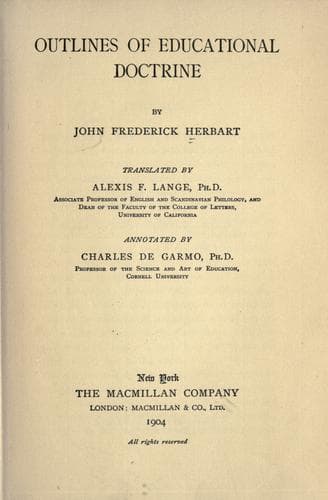
Outlines of Educational DoctrineHerbart, Johann Friedrich
Philosophy
Outlines of Educational Doctrine
Herbart, Johann Friedrich
Education -- Philosophy
To reasons of this kind, derived directly from the chief aim of all
teaching and opposed only by tradition (the conventional _doing_ of
the classics), the philologists will have to listen some time, if they
are not willing that, with the growing importance of history and of
the natural sciences, and with the increasing pressure of material
interests, the study of Greek in schools should be pushed into a corner
and suffer a reduction similar to that which has already taken place
in the case of Hebrew. (A few decades ago Greek came very near being
remitted for all but those intending to study theology.)
Of course, the “Odyssey” possesses no miraculous power to inspire
those who have no talent whatever for language studies or do not take
them seriously; nevertheless, as many years of experience have shown,
it surpasses every other work of antiquity that might be selected in
definite pedagogical effect. Moreover, its study does not preclude
an early commencement of Latin (nor even of Greek, where that seems
necessary); only Latin cannot be pushed with the customary rapidity
at the same time; for the “Odyssey” requires an hour daily, and
grammatical and lexicological work besides.
Experience has proved that the grammatical rudiments pertaining to
declension and conjugation must be worked over very carefully first,
although reduced to what is absolutely essential. Besides, the first
lessons in the “Odyssey” ought not to exceed a few lines each time;
and, during the first months, no accurate memorizing of words is to
be demanded. But farther on the acquisition of a vocabulary must be
vigorously insisted on; in fact, it becomes the pupil’s most necessary
collateral work. By continued effort in this direction a considerable
portion of the whole stock of words is gradually acquired; the language
forms are supplied with the content to which they refer, and through
which they become significant. The teacher must know exactly, not only
when to hasten on, but also when to delay; for every perceptible gain
in facility is likely to betray pupils into some carelessness which
needs to be corrected at once. With good pupils it is not infeasible
to read the whole of the “Odyssey,” since facility increases very
rapidly toward the end. Nevertheless, such work should not extend much
beyond two years; otherwise weariness sets in, or time is taken from
other things. In schools it will be well to assign the first four books
to one class, perhaps the class composed of pupils nine or ten years
old, the next class to begin with Book V. To determine exactly how
many books each class can work up thoroughly is unnecessary, as good
translations can be used to fill in the gaps that occur. The reason
for the division just made will be manifest at once upon a closer
inspection of the “Odyssey.” Some books more advanced pupils may later
on read by themselves, but they should be expected to render an account
of what they are doing. It is not necessary at this stage to explain in
Public-domain text, read in full here on John Shaqi.
Reviews
Reviews
No reviews yet
Be the first to share your thoughts on this work.
Elsewhere in the archive
Join the Discussion
Join the discussion
Sign in to leave a comment or review.
Sign InorCreate an account