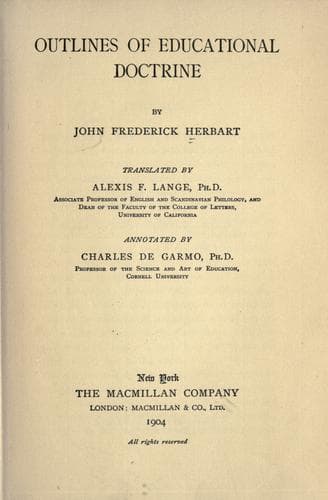
Outlines of Educational DoctrineHerbart, Johann Friedrich
Philosophy
Outlines of Educational Doctrine
Herbart, Johann Friedrich
Education -- Philosophy
detail the rarer peculiarities of the Homeric dialect. Such things may
well be deferred until, later in the course, the study of Homer (of
the “Iliad”) is resumed. The teacher who is afraid of the difficulties
connected with the plan presented should remind himself of the fact
that progress by any other path is equally beset with difficulties.
While at work on Homer, care should be taken to keep pupils from being
influenced simultaneously by such tales as those from the Arabian
Nights, because they blunt the sense of the wonderful.
[41] These reasons apply in no way to the “Iliad,” but only to
the “Odyssey.” Moreover, it is presupposed that religious feeling
has been sufficiently awakened long beforehand. In that case the
mythical elements can do no harm whatever, for, in so far as they
are inconsistent with religious feeling, their effect is decidedly
repellent, and renders an excess of illusion impossible.
284. Only two poets, two historians, and two philosophers need to be
mentioned to indicate the continuation of the course. Homer and Virgil;
Herodotus and Cæsar; Plato and Cicero. What authors should precede
these, or should intervene, or follow, may be left for circumstances
to determine. Xenophon, Livy, Euripides, Sophocles, and Horace will
probably always retain a place by the side of those mentioned; Horace
especially offers brief maxims, the after-effect of which the educator
should by no means underestimate. It is obvious that Virgil and
Herodotus are rendered much easier by taking up Homer first; on the
other hand, the return to Homer (to the “Iliad”) during adolescence, is
as little to be omitted, if only on account of mythology, as the return
to ancient history for purposes of pragmatic study (250). Again, the
syntactical scheme of the ancient languages, which involves far greater
difficulties than do even inflections and vocabulary, is more easily
mastered by placing the poets before the prose-writers, because then
the pupils are not compelled to struggle with all the difficulties of
sentence structure at once. At any rate, it is desirable that, just
as the student’s Greek vocabulary is built up from the “Odyssey,” his
hoard of Latin words should be drawn from the “Æneid.” The latter,
however, will hardly be read entirely, because it cannot be gone over
with nearly the same rapidity as the latter books of the “Odyssey,”
when facility in reading has been attained. Cæsar’s “Bellum Gallicum”
must be studied with exceptional carefulness, since its style comes
nearer to being a desirable first model for the student of Latin
than the style of the other authors in use. After this has been
accomplished, the strictly systematic teaching and memorizing of Latin
syntax, together with selected brief examples, is in order as one of
the main lines of work. In Plato several books of the “Republic,”
especially the first, second, fourth, and eighth, constitute a
desirable goal. That Cicero should be revealed to young minds on his
Public-domain text, read in full here on John Shaqi.
Reviews
Reviews
No reviews yet
Be the first to share your thoughts on this work.
Elsewhere in the archive
Join the Discussion
Join the discussion
Sign in to leave a comment or review.
Sign InorCreate an account