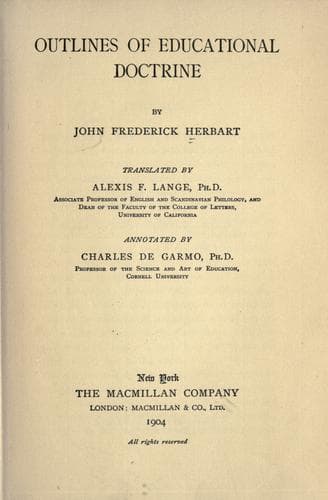
Outlines of Educational DoctrineHerbart, Johann Friedrich
Philosophy
Outlines of Educational Doctrine
Herbart, Johann Friedrich
Education -- Philosophy
300. Among the various masses of ideas (29) some necessarily acquire
permanent predominance, others come and go. But if this relation
reaches full development and becomes fixed too early, the controlling
ideas no longer admit of being arrested to the extent necessary
for the reception of the new material offered by instruction. This
fact explains the experience that clever boys, notwithstanding the
best intentions to receive instruction, yet frequently appear very
unreceptive, and that a certain rigidity of mind, which in later
manhood would not occasion surprise, seems to have strayed, as it
were, into boyhood. No one should allow himself to be betrayed into
encouraging such narrowness by commendatory terms such as pertain to
strength and energy; just as little, however, should clumsy teaching
and its sequel, listless learning, be left out of account, as having no
bearing on this state of affairs.
For, rather may it be assumed that the fault mentioned might have been
largely forestalled by very early instruction of all kinds, provided
such instruction had been combined with a variety of attractive
rather than of too difficult tasks. Where, on the other hand, mental
nervousness has once taken root, it cannot be eradicated by all the art
and painstaking effort of a multitude of teachers. When the questions
of a child, six years old let us say, give rise to the apprehension
that they proceed from a too contracted mental horizon, there should be
no delay about resorting to manifold forms of stimulation, especially
in the way of widening the pupil’s experience to the greatest
practicable extent.
301. On the other hand, it is not rare to find boys, and even young
men, in whose minds no one thought-mass attains to any very prominent
activity. Such boys are always open to every impression and ready for
any change of thought. They are wont to chat pleasantly, and to form
hasty attachments. Here belong those who learn easily and forget as
quickly.
This defect, too, when once confirmed, resists all skill and good
intentions; strength of purpose, from the very nature of the case,
is out of the question. The situation varies in gravity, however,
according to the influences of the earliest environment. If these
proved distracting, the fault mentioned assumes alarming proportions
even in minds otherwise well endowed. But where some form or other
of necessary respect has been steadily at work, the youth will raise
himself to a higher plane than the boy gave promise of doing. Least
of all, however, can the teacher allow himself to be betrayed into
hoping for a future development of talent by superficial alertness,
combined, it may be, with droll fancies, bold pranks, and the like.
Talent reveals itself through persistent endeavor, sustained even under
circumstances little favorable to it, and not until such endeavor
clearly manifests itself is the thought of giving it support to be
entertained.
Public-domain text, read in full here on John Shaqi.
Reviews
Reviews
No reviews yet
Be the first to share your thoughts on this work.
Elsewhere in the archive
Join the Discussion
Join the discussion
Sign in to leave a comment or review.
Sign InorCreate an account