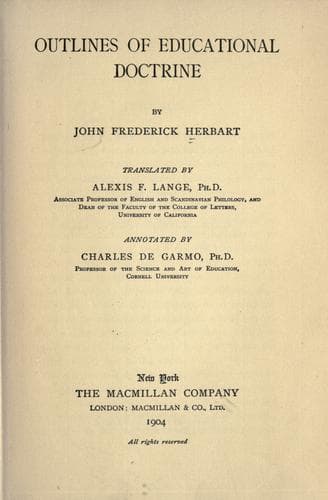
Outlines of Educational DoctrineHerbart, Johann Friedrich
Philosophy
Outlines of Educational Doctrine
Herbart, Johann Friedrich
Education -- Philosophy
The two faults under discussion may indeed come to light only in the
course of time; nevertheless, they are inherent faults, and can be
mitigated, to be sure, but not completely cured.
302. Far easier to deal with are the erratic movements of energetic
characters capable of ardent enthusiasm. The mere thoroughness and
many-sidedness of good instruction, which emphasizes and aims to
effect rational connection and balance of mind, obviously supply the
corrective.
303. Originally it would have been easier to have prevented those
faults which are due to the mismanagement or to the omission of early
government, instruction, or training. But with time, the difficulties
of a cure grow in a very rapid ratio. In general, it is well to note
that the teacher has every reason to congratulate himself, if, after
early neglect, there appear under improved treatment some belated
traces of those questions which belong to the sixth or seventh year of
childhood (213).
CHAPTER II
=The Sources of Moral Weakness=
304. Under this head five main points come up for consideration:--
(1) Tendencies of the child’s will impulses.
(2) Ethical judgments and their absence.
(3) Formation of maxims.
(4) Organization of maxims.
(5) Application of organized maxims.
305. (1) Where training has not provided for occupation and for the
distribution of time, we must always expect to encounter an activity
which has no aim, and which forgets its own purposes. From such a state
of affairs arise a craving for liberty averse to all control, and,
where several pupils are grouped together, contention, either for the
possession of something or for the sake of showing off. Each wants
to be first; recognition of the just equality of all is deliberately
refused. Mutual ill-will intrenches itself and stealthily waits for an
opportunity to break forth. Here is the fountain head of many passions;
even those which spring from excessive sensuousness must be classed
under this first head, in so far as they are promoted by lack of
regulated activity. The havoc caused by passions is a pervading element
in the discussion of all of the remaining topics.
306. (2) It is true that education usually counteracts the tendency to
indolence and to unruliness, not only by the use of the spur and the
bridle, but also through guidance in the direction of the proprieties;
giving rise to the thought “what will others say,” it shows existing
conditions as mirrored in the minds of others. But when these others
are compelled to remain silent, or when the pupil is sure of their
partiality, or is exposed to their errors of judgment, the effect is to
vitiate rather than to arouse the ethical judgment.
Public-domain text, read in full here on John Shaqi.
Reviews
Reviews
No reviews yet
Be the first to share your thoughts on this work.
Elsewhere in the archive
Join the Discussion
Join the discussion
Sign in to leave a comment or review.
Sign InorCreate an account