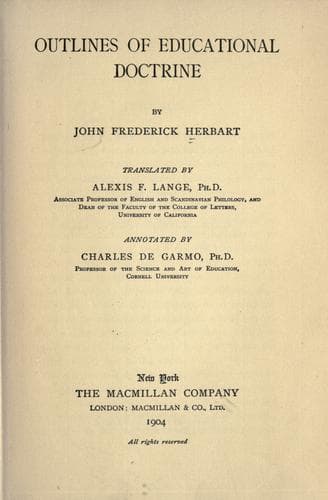
Outlines of Educational DoctrineHerbart, Johann Friedrich
Philosophy
Outlines of Educational Doctrine
Herbart, Johann Friedrich
Education -- Philosophy
Nevertheless, calling attention to the judgment of others, and not
merely of particular individuals, is very much better than waiting
for the spontaneous awakening of ethical judgment. In most cases the
waiting would be in vain. Matters of ethical import are either too
close to the ordinary human being, and so, of course, to the boy left
entirely to himself, or they are too remote, _i.e._, either they have
not as yet passed outside the pale of affection or aversion, or else
they are already fading from the field of vision. In neither case can
an ethical judgment be formed with success. At any rate, it will vanish
before it can produce an effect.
In order to reach those ethical judgments on which morality rests, the
child must see will images, see them without the stirring of his own
will impulse.
These will images, moreover, must embrace relations, the single members
of which are themselves wills, and the beholder is to keep such members
equally in sight, until the estimate of value rises spontaneously
within him. But such contemplation implies a keenness and calmness of
apprehension not to be looked for in unruly children. Hence it may
be inferred how necessary training is--serious, not to say severe,
training. Unruliness must have been tamed and regular attention
secured. The preliminary condition fulfilled, it is further essential
that there shall be no lack of sufficiently distinct presentations of
the foregoing will images. And even then the ethical judgment often
matures so tardily that it has to be pronounced in the name of other
persons--persons higher in authority.
307. In this connection the instances of one-sidedness of ethical
judgment must not be overlooked, such as occur when one of the
practical ideas stands out more prominently than another, or when that
which is outwardly proper rises above them all.
308. (3) All desires persistently operative and productive of
fluctuating states of emotional excitement, therefore rightly called
passions, lead to experiential knowledge of the beneficial and the
injurious. The beneficial suggests frequent repetition in the future,
the injurious continued avoidance. Accordingly rules of life take
shape, and the resolution always to observe them is made. In other
words, maxims result.
From simple resolution to actual observance is still, to be sure, a far
cry. But the claim for the universal validity of the rule, so that the
individual may regard it as applicable to others as well as to himself,
enters the mind far more directly by way of desires which point forward
to similar cases in the future, than it does under the guidance of
ethical judgments whose universal element is abstracted from given
single instances with difficulty. In fact, this difficulty is often so
great that the ethical judgment itself may be missed in the search for
the universal.
Public-domain text, read in full here on John Shaqi.
Reviews
Reviews
No reviews yet
Be the first to share your thoughts on this work.
Elsewhere in the archive
Join the Discussion
Join the discussion
Sign in to leave a comment or review.
Sign InorCreate an account