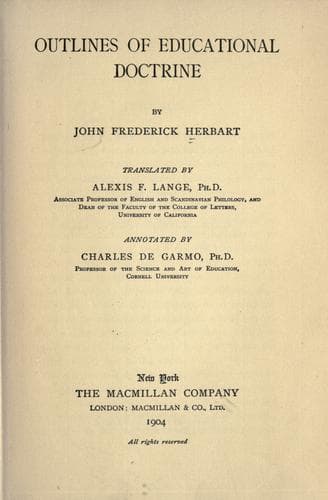
Outlines of Educational DoctrineHerbart, Johann Friedrich
Philosophy
Outlines of Educational Doctrine
Herbart, Johann Friedrich
Education -- Philosophy
309. Now, the promptness and loyalty of obedience to the sum total of
duties, once recognized as such and fixed through the maxims adopted,
are passed upon by the moral judgment. Correct moral judgment,
therefore, presupposes true insight into the value of will, which
insight again can be obtained only through the ethical estimate as a
whole. But in view of the circumstances pointed out a moment ago, we
must expect to come upon maxims that are false or at least inaccurate.
Under the latter head fall points of honor, social obligations, fear of
ridicule.
310. (4) Maxims ought to form a unit, but in youth they are not fully
determined even singly, much less are they closely united into a
definite whole. The proviso of exceptions still clings to them, so also
that of future tests through experience.
The maxims arising out of the desires and pleasures can never be
brought into perfect union with those springing from ethical judgments.
Accordingly the wrong subordination takes place, or, at all events, a
contamination of the latter by the former.
311. (5) In the application of maxims more or less unified, the
volition of the moment is apt to prove stronger than the previous
resolves. Hence, man becomes only too prone to condone and fall in
with discriminations between theory and practice. The consequence is a
certain moral empiricism, which, if nothing else will do to justify its
disregard of moral law, falls back upon pious feelings. Plans of action
are formed without regard to maxims, but with the apparent compensation
of another kind of morally regular life.
Such contempt of moral judgment gains ground and spreads ruin all the
more, the farther the ethical judgments on which morality must rest
fall short of the clearness that ought to mark them, and the cruder
the pupil’s knowledge is of the antithesis between them and maxims of
utility or pleasure.
312. The natural aid to the formation and union of maxims is the
system of practical philosophy itself. But the teaching of it involves
difficulties. One of them is that such marked differences occur among
young men in the relation of systematic exposition to the grade of
culture which they have attained. For observations of this nature,
religious instruction prior to confirmation provides an early
opportunity. How such instruction is to be given, is, of course, by
no means immaterial, but, after all, the moral sentiments, which it
gathers together and strengthens, must, in substance, already exist.
Public-domain text, read in full here on John Shaqi.
Reviews
Reviews
No reviews yet
Be the first to share your thoughts on this work.
Elsewhere in the archive
Join the Discussion
Join the discussion
Sign in to leave a comment or review.
Sign InorCreate an account