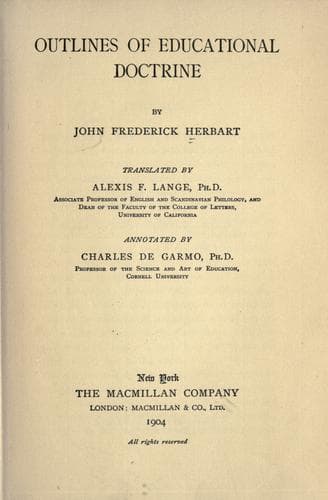
Outlines of Educational DoctrineHerbart, Johann Friedrich
Philosophy
Outlines of Educational Doctrine
Herbart, Johann Friedrich
Education -- Philosophy
Again, if the end sought were more strictly scientific form for the
moral sentiments, there would have to be ground for presuming that
the student is able to appreciate that form and has acquired skill
in the use of logical methods. The study of logic, together with
appropriate exercises, would obviously be a necessary preliminary step.
Prerequisites like these need to be borne in mind, especially in the
case of lower schools and all other institutions that do not, as a
rule, lead to the university.
313. Erroneous systems of ethics, moreover, might occasion the adoption
of very absurd measures, concerning which, on account of the importance
of the subject, at least something has to be said. Everything would be
turned upside down, if, instead of bringing together and uniting maxims
under the concept virtue, the attempt were made to deduce from some one
formula of the categorical imperative a multiplicity of maxims and from
these, rather than from the original ethical judgments, the estimates
of will values, the final undertaking being, perhaps, to divert the
will itself by such operations.
On the contrary, the will must early have been given such direction by
government and training, that its lines of tendency will of themselves
coincide as nearly as possible with the paths disclosed later, when
the pupil is being shown the way through ethical judgments. Those
beginnings of evil noted above (305) must not be permitted to appear at
all, for their consequences usually prove ineradicable. But even so, it
is not certain that a way can be hewn through the errors of others to
truer judgments. When, however, both ends have been gained, experience
and history and literature must next be called in, in order to show
clearly the confusion into which the maxims based upon pleasure and
passion plunge human beings. Not until now has the time come for more
or less systematic lectures, or for the study of suitable classical
writers. Lastly, there will still be need of frequent appeals to moral
obedience, and it will be found necessary to reinforce these appeals by
reflections of a religious character.
CHAPTER III
=The Effects of Training=
314.
A. Training prevents passions in that it:--
(1) satisfies needs,
(2) avoids opportunities for violent desires,
(3) provides employment,
(4) accustoms to order,
(5) demands reflection and responsibility.
B. Training influences the emotions in that it:--
(1) checks violent outbreaks,
(2) creates other emotions,
(3) and supplements self-control.
Public-domain text, read in full here on John Shaqi.
Reviews
Reviews
No reviews yet
Be the first to share your thoughts on this work.
Elsewhere in the archive
Join the Discussion
Join the discussion
Sign in to leave a comment or review.
Sign InorCreate an account