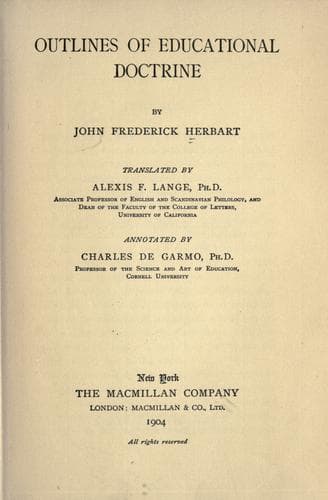
Outlines of Educational DoctrineHerbart, Johann Friedrich
Philosophy
Outlines of Educational Doctrine
Herbart, Johann Friedrich
Education -- Philosophy
C. Training impresses the courtesies of life (counteracts bad
manners), consequently:--
(1) the deportment of individuals is made approximately uniform;
(2) the number of possible points of social contact becomes much
greater than where strife and contention rule;
(3) while the development of one or the other individual is
checked, the more important energies are not stifled, provided
excess of severity be avoided.
D. Training makes cautions, for:--
(1) It restricts foolhardiness,
(2) It warns against dangers,
(3) It punishes in order to make wiser,
(4) It observes and accustoms the human being to the thought of
being observed.
315. Looked at as a whole, these obvious and familiar effects of
training show at once that, generally speaking, its power to lessen
evil is very great, and that it is capable of effectively acting upon
the interrelations of various masses of ideas. But they suggest also
the presence of danger. Training, by driving evil from the surface, may
give rise to clandestine deeds.
316. When this happens, the relations between teacher and pupils grow
increasingly abnormal, since secret practices become general and
concerted, and the pupils assume a studied behavior in the presence of
the teacher.
The consequences are well known:--Inexorable severity in dealing with
concealed offences when discovered; great leniency in the case of open
transgressions; recourse to the machinery of supervision, often even to
secret watching, in order that the system of concealment may not get
the better of education.
317. It lowers the dignity of the teacher to take part habitually
in a competition between spy and concealers. He must not demand to
know everything, although he ought not to allow his confidence to be
victimized by clumsy or long-continued deception.
Such difficulties, however, only make it more intensely necessary
that the foundation of education be laid during the earliest years,
when supervision is still easy, and the heart is reached by formative
influences with greater certainty than ever afterward, and that, if
possible, families should not for any length of time lose sight of
their own members.
Ethical and moral judgments can be simulated; the finest maxims and
principles may be learned by rote; piety may be put on as a cloak.
Unmask the hypocrite, however, and turn him out, and, forthwith, he
plays his game over again elsewhere. Nothing remains but recourse to
severity which deters, and constant occupation under close supervision
in another quarter, in order that he may get away from the hiding
places of his misdeeds. Sometimes banishment is capable of bringing
about improvement.
Public-domain text, read in full here on John Shaqi.
Reviews
Reviews
No reviews yet
Be the first to share your thoughts on this work.
Elsewhere in the archive
Join the Discussion
Join the discussion
Sign in to leave a comment or review.
Sign InorCreate an account