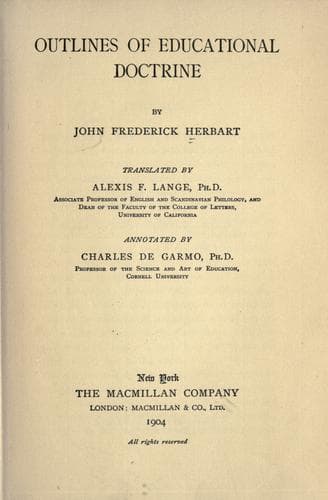
Outlines of Educational DoctrineHerbart, Johann Friedrich
Philosophy
Outlines of Educational Doctrine
Herbart, Johann Friedrich
Education -- Philosophy
318. The will is most directly tractable in social relations, where it
appears as common will. In infancy, the child, wholly devoted to his
mother, is manageable through her; at a later period training is surest
of success when it promotes attachments among the young and carefully
fosters the seeds of goodness. The social ideas, purified by teaching,
must gradually be added.
319. But as far back as boyhood, factions spring up and exclusive
sets are formed, facts which the teacher cannot permit to elude his
vigilance.
When a kind of authority is granted to some older and tried pupils
over those younger and less mature in judgment, the former become
responsible; but the latter are not on that account relieved of all
reflection on their own part, nor are they obliged to submit to every,
though plainly unreasonable, demand of the former.
CHAPTER IV
=Special Faults=
320. First of all it is necessary to distinguish between those faults
which the pupil commits and those which he has. Not all faults one
commits are direct manifestations of those he possesses; but those
which are committed repeatedly may grow permanent. This truth must be
made clear, and must be impressed upon the mind of the pupil to the
full extent of his powers of comprehension.
321. In the case of false steps caused from without by unnoticed
pitfalls, or made in spite of a firm resolve to the contrary, the pupil
is himself usually frightened by what he has done. If so, all depends
on the gravity of his offence as compared with the degree of his horror.
There is a host of minor faults, blunders, and even acts resulting in
damage, which tax the patience of the teacher severely; but it would
imply a mistaken conception of the difficulty of moral education, if
he should repel the frankness of his pupils by harsh treatment of such
offence. Frankness is too essential a factor to be sacrificed; once
gone it will hardly ever wholly return.
322. But the first lie uttered with evil intent, the first act of
theft, and similar actions positively detrimental to morality or
health, have to be dealt with severely, and always in such a way that
the pupil who thought he was permitting himself a slight fault, is made
to experience most thoroughly both fear and censure.
323. Serious treatment of a first offence is demanded also where pupils
try to see how far they may safely disregard authority and command.
It is important, however, not to overestimate the intention of these
attempts; important also to exhibit strength, but not anger. Yet
there are cases where the teacher must seem to act with some warmth,
because the necessary treatment, if combined with coldness, would only
intensify bitterness and cause pain an inordinate length of time. But
very likely as much feeling as is expedient will show itself upon
simply laying aside the assumed coldness.
Public-domain text, read in full here on John Shaqi.
Reviews
Reviews
No reviews yet
Be the first to share your thoughts on this work.
Elsewhere in the archive
Join the Discussion
Join the discussion
Sign in to leave a comment or review.
Sign InorCreate an account