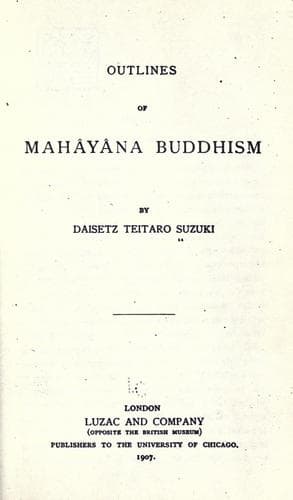
Outlines of Mahayana BuddhismSuzuki, Daisetz Teitaro
Religion
Outlines of Mahayana Buddhism
Suzuki, Daisetz Teitaro
Mahayana Buddhism -- Doctrines
The same mode of reasoning holds good in the case of Mahâyânism, and
it would be absurd to insist on the genuineness of Hînayânism at the
expense of the former. Take for granted that the Mahâyâna school of
Buddhism contains some elements absorbed from other Indian
religio-philosophical systems; but what of it? Is not Christianity
also an amalgamation, {14} so to speak, of Jewish, Greek, Roman,
Babylonian, Egyptian, and other pagan thoughts? In fact every healthy
and energetic religion is historical, in the sense that, in the course
of its development, it has adapted itself to the ever-changing
environment, and has assimilated within itself various elements which
appeared at first even threatening its own existence. In Christianity,
this process of assimilation, adaptation, and modification has been
going on from its very beginning. As the result, we see in the
Christianity of to-day its original type so metamorphosed, so far as
its outward appearance is concerned, that nobody would now take it for
a faithful copy of the prototype.
_Mahâyânism a Living Faith._
So with Mahâyânism. Whatever changes it has made during its historical
evolution, its spirit and central ideas are all those of its founder.
The question whether or not it is genuine, entirely depends on our
interpretation of the term “genuine.” If we take it to mean the
lifeless preservation of the original, we should say that Mahâyânism
is not the genuine teaching of the Buddha, and we may add that
Mahâyânists would be proud of the fact, because being a living
religious force it would never condescend to be the corpse of a
by-gone faith. The fossils, however faithfully preserved, are nothing
but rigid inorganic substances from which life is forever departed.
{15} Mahâyânism is far from this; it is an ever-growing faith and
ready in all times to cast off its old garments as soon as they are
worn out. But its spirit originally inspired by the “Teacher of Men
and Gods” (_çâstadevamanuṣyânam_) is most jealously guarded against
pollution and degeneration. Therefore, as far as its spirit is
concerned, there is no room left to doubt its genuineness; and those
who desire to have a complete survey of Buddhism cannot ignore the
significance of Mahâyânism.
Public-domain text, read in full here on John Shaqi.
Reviews
Reviews
No reviews yet
Be the first to share your thoughts on this work.
Join the Discussion
Join the discussion
Sign in to leave a comment or review.
Sign InorCreate an account