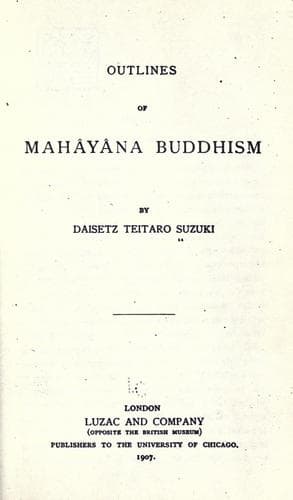
Outlines of Mahayana BuddhismSuzuki, Daisetz Teitaro
Religion
Outlines of Mahayana Buddhism
Suzuki, Daisetz Teitaro
Mahayana Buddhism -- Doctrines
This is very unfair on the part of the critics, because what religion
is there in the whole history of mankind that has not made any
development whatever, that has remained the same, like the granite,
throughout its entire course? Let us ask whether there is any religion
which has shown some signs of vitality and yet retained its primitive
form intact and unmodified in every respect. Is not changeableness,
that is, susceptibility to irritation the most essential sign of
vitality? Every organism grows, which means a change in some way or
other. There is no form of life to be found anywhere on earth, that
does not grow or change, or that has not any inherent power of
adjusting itself to the surrounding conditions.
Take, for example, Christianity. Is Protestantism the genuine teaching
of Jesus of Nazareth? or does Catholicism represent his true spirit?
Jesus himself did not have any definite notion of Trinity doctrine,
nor did he propose any suggestion for ritualism. According to the
Synoptics, he appears to have cherished a rather immature conception
of the kingdom of God than a purely ideal one as conceived by Paul,
and his personal disciples who were just as illiterate philosophically
as the master himself were anxiously waiting in all probability for
its mundane realisation. But what Christians, Catholics or Protestants,
in these days of enlightenment, would dare {13} give a literal
explanation to this material conception of the coming kingdom?
Again, think of Jesus’s view on marriage and social life. Is it not an
established fact that he highly advocated celibacy and in the case of
married people strict continence, and also that he greatly favored
pious poverty and asceticism in general? In these respects, the monks
of the Medieval Ages and the Catholic priests of the present day
(though I cannot say they are ascetic and poor in their living) must
be said to be in more accord with the teaching of the master than
their Protestant brethren. But what Protestants would seriously
venture to defend all those views of Jesus, in spite of their avowed
declaration that they are sincerely following in the steps of their
Lord? Taking all in all, these contradictions do not prevent them,
Protestants as well as Catholics, from calling themselves Christians
and even good, pious, devoted Christians, as long as they are
consciously or unconsciously animated by the same spirit, that was
burning in the son of the carpenter of Nazareth, an obscure village of
Galilee, about two thousand years ago.
Public-domain text, read in full here on John Shaqi.
Reviews
Reviews
No reviews yet
Be the first to share your thoughts on this work.
Join the Discussion
Join the discussion
Sign in to leave a comment or review.
Sign InorCreate an account