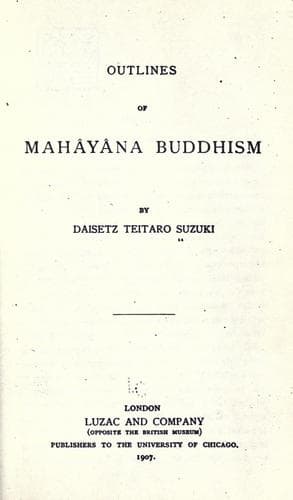
Outlines of Mahayana BuddhismSuzuki, Daisetz Teitaro
Religion
Outlines of Mahayana Buddhism
Suzuki, Daisetz Teitaro
Mahayana Buddhism -- Doctrines
The solution of religious problems, as far as they fall within the
sphere of relative experience, is largely {28} a matter of personal
conviction, determined by one’s intellectual development, external
circumstances, education, disposition, etc. The conceptions of faith
thus formulated are naturally infinitely diversified; even among the
followers of a certain definite set of dogmas, each will understand
them in his own way, owing to individual peculiarities. If we could
subject their conceptions of faith to a strict analysis as a chemist
does his materials, we should detect in them all the possible forms of
differentiation. But all these things belong to the exterior of
religion and have nothing to do with the essentials which underlie
them.
The abiding elements of religion come from within, and consist mainly
in the mysterious sentiment that lies hidden in the deepest depths of
the human heart, and that, when awakened, shakes the whole structure
of personality and brings about a great spiritual revolution, which
results in a complete change of one’s world-conception. When this
mysterious sentiment finds expression and formulates its conceptions
in the terms of intellect, it becomes a definite system of beliefs,
which is popularly called religion, but which should properly be
termed dogmatism, that is, an intellectualised form of religion. On
the other hand, the outward forms of religion consist of those
changing elements that are mainly determined by the intellectual and
moral development of the times as well as by individual esthetical
feelings.
True Christians and enlightened Buddhists may, therefore, find their
point of agreement in the recognition {29} of the inmost religious
sentiment that constitutes the basis of our being, though this
agreement does by no means prevent them from retaining their
individuality in the conceptions and expressions of faith. My
conviction is: If the Buddha and the Christ changed their accidental
places of birth, Gautama might have been a Christ rising against the
Jewish traditionalism, and Jesus a Buddha, perhaps propounding the
doctrine of non-ego and Nirvâna and Dharmakâya.
However great a man may be, he cannot but be an echo of the spirit of
the times. He never stands, as is supposed by some, so aloof and
towering above the masses as to be practically by himself. On the
contrary, “he,” as Emerson says, “finds himself in the river of the
thoughts and events, forced onward by the ideas and necessities of his
contemporaries.” So it was with the Buddha, and so with the Christ.
They were nothing but the concrete representatives of the ideas and
feelings that were struggling in those times against the established
institutions, which were degenerating fast and menaced the progress of
humanity. But at the same time those ideas and sentiments were the
outburst of the Eternal Soul, which occasionally makes a solemn
announcement of its will, through great historical figures or through
great world-events.
Public-domain text, read in full here on John Shaqi.
Reviews
Reviews
No reviews yet
Be the first to share your thoughts on this work.
Join the Discussion
Join the discussion
Sign in to leave a comment or review.
Sign InorCreate an account