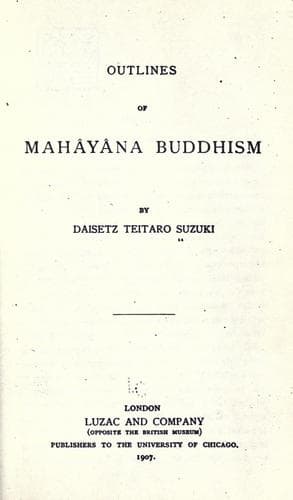
Outlines of Mahayana BuddhismSuzuki, Daisetz Teitaro
Religion
Outlines of Mahayana Buddhism
Suzuki, Daisetz Teitaro
Mahayana Buddhism -- Doctrines
* * *
Believing that a bit of religio-philosophical exposition as above
indulged will prepare the minds of {30} my Christian readers sincerely
to take up the study of a religious system other than their own, I now
proceed to a systematical elucidation of the Mahâyâna Buddhism, as it
is believed at present in the Far East.
CHAPTER I.
A GENERAL CHARACTERISATION OF BUDDHISM.
{31}
_No God and no Soul._
/Buddhism/ is considered by some to be a religion without a God and
without a soul. The statement is true and untrue according to what
meaning we give to those terms.
Buddhism does not recognise the existence of a being, who stands aloof
from his “creations,” and who meddles occasionally with human affairs
when his capricious will pleases him. This conception of a supreme
being is very offensive to Buddhists. They are unable to perceive any
truth in the hypotheses, that a being like ourselves created the
universe out of nothing and first peopled it with a pair of sentient
beings; that, owing to a crime committed by them, which, however,
could have been avoided if the creator so desired, they were condemned
by him to eternal damnation; that the creator in the meantime feeling
pity for the cursed, or suffering the bite of remorse for his somewhat
rash deed, despatched his only beloved son to the earth for the
purpose of rescuing mankind from universal misery, etc., etc. If
Buddhism is called atheism on account of its {32} refusal to take
poetry for actual fact, its followers would have no objection to the
designation.
Next, if we understand by soul âtman, which, secretly hiding itself
behind all mental activities, direct them after the fashion of an
organist striking different notes as he pleases, Buddhists outspokenly
deny the existence of such a fabulous being. To postulate an
independent âtman outside a combination of the five Skandhas[7], of
which an individual being is supposed by Buddhists to consist, is to
unreservedly welcome egoism with all its pernicious corollaries. And
what distinguishes Buddhism most characteristically and emphatically
from all other religions is the doctrine of non-âtman or non-ego,
exactly opposite to the postulate of a soul-substance which is
cherished by most of religious enthusiasts. In this sense, Buddhism is
undoubtedly a religion without the soul.
To make these points clearer in a general way, let us briefly treat in
this chapter of such principal tenets of Buddhism as Karma, Âtman,
Avidyâ, Nirvâna, Dharmakâya, etc. Some of these doctrines being the
common property of the two schools of Buddhism, Hînayânism and
Mahâyânism, their brief, comprehensive exposition here will furnish
our readers with a general notion about the constitution of Buddhism,
and will also prepare them to pursue a further specific exposition of
the Mahâyâna doctrine which follows.
{33}
_Karma._
Public-domain text, read in full here on John Shaqi.
Reviews
Reviews
No reviews yet
Be the first to share your thoughts on this work.
Join the Discussion
Join the discussion
Sign in to leave a comment or review.
Sign InorCreate an account