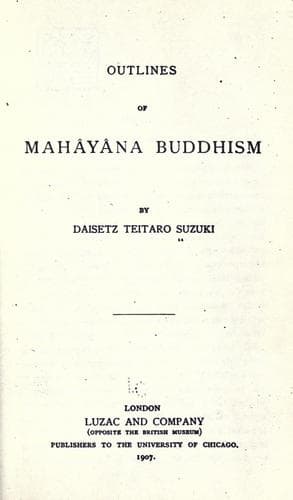
Outlines of Mahayana BuddhismSuzuki, Daisetz Teitaro
Religion
Outlines of Mahayana Buddhism
Suzuki, Daisetz Teitaro
Mahayana Buddhism -- Doctrines
[a20] The two prejudices or obstacles that lie in our way to
enlightenment are: 1 that which arises from intellectual
shortsightedness; 2. that which arises from impurity of heart.
[a21] _Sûtra on Mahâkâṣyapa’s Question Concerning the Absolute._
[a22] _Suvarna-Prabhâ Sûtra._
[a23] _Suvarna-Prabhâ Sûtra_, Chap. 26
[a24] _Padmapani Sûtra_, Fas. 8.
[a25] _The Avatamsaka Sutra._
[a26] This means that the heart of the Bodhisattva which is pure and
eternal in its essential nature has nothing added externally to it by
studying the Dharma; for the Dharma is nothing else than the
expression of his own heart.
[a27] The _Avatamsaka_, fas. IX, p. 48. This pantheistic thought of
the One-All is generally considered to be Buddhistic; but the truth is
that every genuine religious sentiment inevitably leads us to this
final conviction. Even in the so-called transcendental monotheistic
Christianity, we find the pantheistic thought boldly proclaimed and
put in contrast to the idea of “our Father which art in Heaven.” For
instance, read the following passage from Thomas à Kempis: “He to whom
all things are one, he who reduceth all things to one, and seeth all
things in one, may enjoy a quiet mind, and remain at peace in God.”
(Chap. III.) The passage in the Gospel of John declaring that “the
Father is in me and I in him,” when logically carried out, comes to
echo the same sentiment entertained by Buddhists, who recognise a
manifestation of the Dharmakâya in all beings, animate as well as
inanimate. The Christianity of to-day is that of Paul as expounded in
his letters, but the future one will advance a few steps more and will
be that of John.
[a28] From the _Avatamsaka Sutra_.
[a29] From the _Avatamsaka Sutra_.
INDEX.
{409}
Abhimukî (sixth stage of Bodhisattvahood), 318.
Acalâ (eighth stage of Bodhisattvahood), 322.
Açoka, King, 49.
Açrava (evil), explained, 249 ft.
Açûnya, 22, 95.
Açvaghosha, 4, 8, 61 ft., 65 ft., 111, 115; on Âlaya, 66 ft., 129, 139
ft.; _Awakening of Faith_, 7; on Suchness, 99; on Ignorance, 118; and
Dionysius, 102 ft.; _Buddhacarita_, quoted, 147; on Mahâyânism, 246;
on the Sambhogakâya, 258, 333.
Agnosticism, 25.
Âlaya (or Âlaya-vijñâna), All-conserving Soul, 66; as depository of
“germs”, 66; creator of the universe, 68; and the Garbha, 125 et seq.;
its evolution, 128; and the soul, 165; and the twelve nidânas, 183.
Amitâbha, 207, 219, 269.
Anânârtha (non-particularisation), 72.
Ânanda attempts to locate the soul, 157.
Ânâpânam, exercise in breathing, 53 ft.
Arada, 146.
Arcismatî (fourth stage of Bodhisattvahood), 316.
Arhatship and Mahâyânism, 288.
Âryadeva, 3 ft., 8, 60.
Asanga (and Vasubandhu), 4, 62, 65, 69, 87, 88, 153, 231, 234, 263,
354.
{410}
Asceticism repudiated, 52, 53.
Atman, and Samkhyan Lingham, 38; and the Vedantic çarîra, 38; and
Vijñâna, 39; and unity of consciousness, 40; and karma, 41; and
impermanency, 43; and egoism, 44; and the “old man”, 165. (_See also_
“ego” and “soul”.)
Public-domain text, read in full here on John Shaqi.
Reviews
Reviews
No reviews yet
Be the first to share your thoughts on this work.
Elsewhere in the archive
Join the Discussion
Join the discussion
Sign in to leave a comment or review.
Sign InorCreate an account