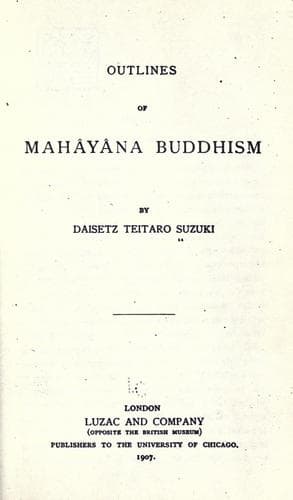
Outlines of Mahayana BuddhismSuzuki, Daisetz Teitaro
Religion
Outlines of Mahayana Buddhism
Suzuki, Daisetz Teitaro
Mahayana Buddhism -- Doctrines
Param nirodhâdbhagavân bhavatîtyeva nohyate,
Na bhavatyubhayam ceti nobhayam ceti nohyate:
Atiṣṭhamâno ‘pi bhagavân bhavatîtyeva nohyate,
Na bhavatyubhayam ceti nobhayam ceti nohyate.
(_Mâdhyamika_, p. 199).
[50] He was the third son of king of Kâçi (?) in southern India. He
came to China A.D. 527 and after a vain attempt to convert Emperor Wu
to his own view, he retired to a monastery, where, it is reported, he
spent all day in gazing at the wall without making any further venture
to propagate his mysticism. But finally he found a most devoted
disciple in the person of Shen Kuang, who was once a Confucian, and
through whom the Dhyâna school became one of the most powerful Mahâyâna
sect in China as well as in Japan. Dharma died in the year 535. Besides
the one here mentioned, he had another audience with the Emperor. At
that time, the Emperor said to Dharma: “I have dedicated so many
monasteries, copied so many sacred books, and converted so many bhiksus
and bhiksunis: what do you think my merits are or ought to be?” To
this, however, Dharma replied curtly, “No merit whatever.”
[51] Another interesting utterance by a Chinese Buddhist, who,
earnestly pondering over the absoluteness of Suchness for several
years, understood it one day all of a sudden, is: “The very instant
you say it is something (or a nothing), you miss the mark.”
[52] _The Vimalakîrti Sûtra_, Kumârajîva’s translation, Part II,
Chapter 5.
[53]
Deussen relates, in his address delivered before the Bombay
Branch of the Royal Asiatic Society, 1893, a similar attitude
of a Vedantist mystic in regard to the highest Brahma. “The
Bhava, therefore, when asked by the king Vaksalin, to explain the
Brahman, kept silence. And when the king repeated his request
again and again, the rishi broke out into the answer: ‘I tell it you,
but you don’t understand it; _çânto ’yam âtmâ_, this âtmâ is silence!’”
[54] It is a well-known fact that the Vedanta philosophy, too,
makes a similar distinction between Brahman as sagunam (qualified) and
Brahman as nirgunam (unqualified). The former is relative, phenomenal,
and has characteristics of its own; but the latter is absolute, having
no qualification whatever to speak of, it is absolute Suchness. (See
Max Mueller’s _The Six Systems of Indian Philosophy_, p. 220 et seq.)
Public-domain text, read in full here on John Shaqi.
Reviews
Reviews
No reviews yet
Be the first to share your thoughts on this work.
Elsewhere in the archive
Join the Discussion
Join the discussion
Sign in to leave a comment or review.
Sign InorCreate an account