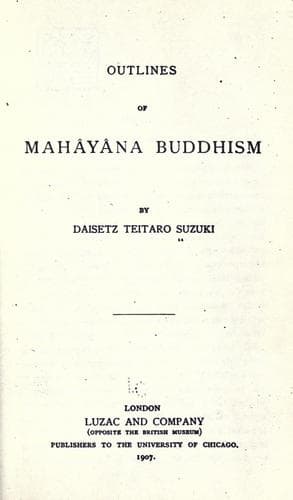
Outlines of Mahayana BuddhismSuzuki, Daisetz Teitaro
Religion
Outlines of Mahayana Buddhism
Suzuki, Daisetz Teitaro
Mahayana Buddhism -- Doctrines
[89] _The Distinguishing of the Mean_, by Vasubandhu. Nanjo, 1248.
[90] “Manhattan’s Streets I Saunter’d, Pondering.” I might have
quoted the whole poem, if not for limitation of space.
[91] If we understand the following words of Tolstoi in the light
which we gain from the Buddhist doctrine of karmaic immortality, we
shall perhaps find more meaning in them than the author himself wished
to impart: “My brother who is dead acts upon me now more strongly than
he did in life; he even penetrates my being and lifts me up towards
him.”
CHAPTER IX NOTES.
[92] The _Avatamsaka Sûtra_, Chinese translation by Buddhabhadra,
fas. XXXIV.
[93] That is the Dharmakâya personified.
[94] In Hindu philosophy space is always conceived as an objective
entity in which all things exist.
[95] This should be understood in the sense that “God maketh his
sun to rise on the evil and on the good, and sendeth rain on the just
and on the unjust.” The Dharmakâya is universal in its love, as space
is in its comprehensiveness. Because it is absolutely free from human
desires and passions that are the product of egoism and therefore tend
always to be discriminative and exclusive.
[96] The four views are: That the physical body is productive of
impurities; that sensuality causes pain; that the individual soul is
not permanent; and that all things are devoid of the Atman.
[97] That is to say: The Dharmakâya, that assumes all forms of
existence according to what class of being it is manifesting itself,
is sometimes conceived by the believers to be a short-lived god,
sometimes an immortal spirit, sometimes a celestial being of one
hundred kalpas, and sometimes an existence of only a moment. As there
are so many different dispositions, characters, karmas, intellectual
attainments, moral environments, etc., so there are as many Dharmakâyas
as subjectively represented in the minds of sentient beings, though
the Dharmakâya, objectively considered, is absolutely one.
[98] Asanga’s _General Treatise on Mahâyânism_. (_Mahâyâna
samparigraha_).
[99] The _Avatamsaka Sûtra_, chap. 13, “On Merit.”
[100] This is by no means the case, for some of the Mahâyâna sûtras
are undoubtedly productions of much later writers than the immediate
followers of the Buddha, though of course it is very likely that some
of the most important Mahâyâna canonical books were compiled within a
few hundred years after the Nirvana of the Master.
Public-domain text, read in full here on John Shaqi.
Reviews
Reviews
No reviews yet
Be the first to share your thoughts on this work.
Elsewhere in the archive
Join the Discussion
Join the discussion
Sign in to leave a comment or review.
Sign InorCreate an account