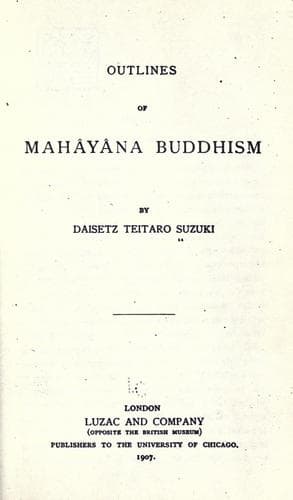
Outlines of Mahayana BuddhismSuzuki, Daisetz Teitaro
Religion
Outlines of Mahayana Buddhism
Suzuki, Daisetz Teitaro
Mahayana Buddhism -- Doctrines
[101] “Purvapranidhânabala” is frequently translated “the power of
original (or primitive) prayer.” Literally, pûrva means “former” or
“original” or “primitive”; and pranidhâna, “desire” or “vow” or
“prayer”; and bala, “power.” So far as literary rendering is concerned,
“power of original prayer” seems to be the sense of the original
Sanskrit. But when we speak of primitive prayers of the Dharmakâya or
Tathâgata, how shall we understand it? Has prayer any sense in this
connection? The Dharmakâya can by its own free will manifest in any
form of existence and finish its work in whatever way it deems best.
There is no need for it to utter any prayer in the agony of struggle
to accomplish. There is in the universe no force whatever which is
working against it so powerfully as to make it cry for help; and there
cannot be any struggle or agony in the activity of the Dharmakâya. The
term prayer therefore is altogether misleading and inaccurate and
implicates us in a grave error which tends to contradict the general
Buddhist conception of Dharmakâya. We must dispense with the term
entirely in order to be in perfect harmony with the fundamental
doctrine of Buddhism. This point will receive further consideration
later.
[102] “I am the father of all beings, and they are my children.”
(The _Avatamsaka_, the _Pundarîka_, etc.)
[103] To get more fully acquainted with the significance of the
Sukhâvatî doctrine, the reader is advised to look up the Sukhâvatî
sûtras in the _Sacred Books of the East_, Vol. XLIX.
CHAPTER X NOTES.
[104] What follows is selected from a short sûtra called _The
Mahâvaipulya-Tathâgatagarbha Sûtra_, translated into Chinese by
Buddhabhadra of the Eastern Tsin dynasty (A.D. 371-420). Nanjo, No.
384.
[105] _Niyuta_ is an exceedingly large number, but generally
considered to be equal to one billion.
[106] All these are unhuman forms of existence, including demons,
dragon-kings, winged beasts, etc.
[107] Âçrava literally means “oozing,” or “flowing out,” and the
Chinese translators rendered it by _lou_, dripping, or leaking. Roughly
speaking, it is a general name for evils, principally material and
sensuous. According to an Indian Buddhist scholar, Âçrava has threefold
sense: (1) “keeping,” for it retains all sentient beings in the
whirlpool of birth and death; (2) “flowing,” for it makes all sentient
beings run in the stream of birth and death; (3) “leaking,” or
“oozing,” for it lets such evils as avarice, anger, lust, etc., ooze
out from the six sense-organs after the fashion of an ulcer, which
lets out blood and filthy substance. The cause of Âçrava is a blind
will, and its result is birth and death. Specifically, Bhâvâçrava is
one of the three Âçravas, which are (1) kâmâçrava, (2) vidyâçrava, and
(3) bhâvâçrava. The first is egotistic desires, the second is
ignorance, and the third is the material existence which we have to
suffer on account of our previous karma.
Public-domain text, read in full here on John Shaqi.
Reviews
Reviews
No reviews yet
Be the first to share your thoughts on this work.
Elsewhere in the archive
Join the Discussion
Join the discussion
Sign in to leave a comment or review.
Sign InorCreate an account