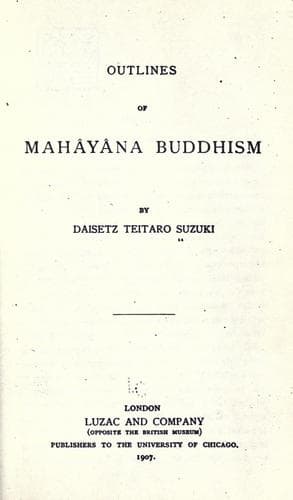
Outlines of Mahayana BuddhismSuzuki, Daisetz Teitaro
Religion
Outlines of Mahayana Buddhism
Suzuki, Daisetz Teitaro
Mahayana Buddhism -- Doctrines
[108] Our thoughtful readers must have noticed here that the
conceptions of the Buddha as entertained by the Mahâsangika School
(Great Council) closely resemble those of the Mahâyâna Buddhism.
Though we are still unable to trace step by step the development of
Mahâyânism in India, the hypothesis assumed by most of Japanese
Buddhist scholars is that the Mahâsangika was Mahâyânistic in tendency.
[109] The _Mahâparinibbâna sutta_.
[110] There are three Chinese translations of this sûtra: the first,
by Dharmarakṣa during the first two decades of the fifth century A.D.;
the second, by Paramârtha of the Liang dynasty, who came to China A.D.
546 and died A.D. 569; and the third, by I-tsing of the Tang dynasty
who came back from his Indian pilgrimage in the year 695 and translated
this sûtra A.D. 703. The last is the only complete Chinese translation
of the _Suvarnâ Prabhâ_. A part of the original Sanskrit text recovered
in Nepal was published by the Buddhist Text Society of India in 1898.
Nanjo, Nos. 126, 127, 130.
[111] The notion that great men never die seems to be universal.
Spiritually they would never perish, because the ideas that moved them
and made them prominent in the history of humanity are born of truth.
And in this sense every person who is possessed of worthy thoughts is
immortal, while souls that are made of trumpery are certainly doomed
to annihilation. But the masses are not satisfied with this kind of
immortality. They must have something more tangible, more sensual, and
more individual. The notion of bodily resurrection of Christ is a fine
illustration of this truth. When the followers of Christ opened the
master’s grave, they did not find his body, so says legend, and they
at once conceived the idea of resurrection, for they reasoned that
such a great man as Jesus could not suffer the same fate that befalls
common mortals only. The story of his corporeal resurrection now
took wing and went wild; some heard him speak to them, some saw him
break bread, and others even touched his wounds. What a grossly
materialistic conception early Christians (and alas, even some of the
twentieth century) cherished about resurrection and immortality! It is
no wonder, therefore, that primitive Buddhists raised a serious
question about the personality of Buddha which culminated in the
conception of the Sambhogakâya, Body of Bliss, by Mahâyânists.
[112] Compare this to the transfigured Christ.
Public-domain text, read in full here on John Shaqi.
Reviews
Reviews
No reviews yet
Be the first to share your thoughts on this work.
Elsewhere in the archive
Join the Discussion
Join the discussion
Sign in to leave a comment or review.
Sign InorCreate an account