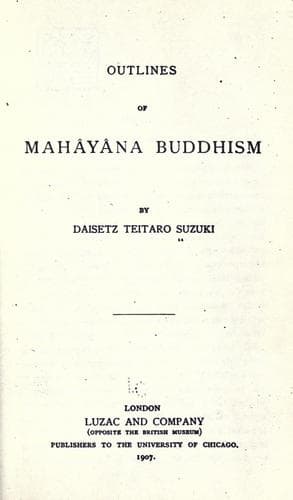
Outlines of Mahayana BuddhismSuzuki, Daisetz Teitaro
Religion
Outlines of Mahayana Buddhism
Suzuki, Daisetz Teitaro
Mahayana Buddhism -- Doctrines
[133] The eighteen unique characteristics which distinguish the
Buddha from the rest of mankind are: (1) He commits no errors. Since
time out of mind, he has disciplined himself in morality, meditation,
intelligence, and lovingkindness, and as the result his present life
is without faults and free from all evil thoughts. (2) He is faultless
in his speeches. Whatever he speaks comes from his transcendental
eloquence and leads the audience to a higher conception of life. (3)
His mind is faultless. As he has trained himself in samâdhi, he is
always calm, serene, and contented. (4) He retains his sameness of
heart (_samâhitacitta_), that is, his love for sentient beings is
universal and not discriminative. (5) His mind is free from thoughts
of particularity (_nânâtvasamjñâ_), that is, it is abiding in truth
transcendental, his thoughts are not distracted by objects of the
senses. (6) Resignation (_upekṣâ_). The Buddha knows everything, yet
he is calmly resigned. (7) His aspiration is unfathomable, that is,
his desire to save all beings from the sufferings of ignorance knows
no bounds. (8) His energy is inexhaustible, which he applies with
utmost vigor to the salvation of benighted souls. (9) His mentation
(_smṛti_) is inexhaustible, that is, he is ever conscious of all the
good doctrines taught by all the Buddhas of the past, present, and
future. (10) His intelligence (_prajñâ_) is inexhaustible, that is,
being in possession of all-intelligence which knows no limits, he
preaches for the benefits of all beings. (11) His deliverance
(_vimukti_) is permanent, that is, he has eternally distanced all evil
passions and sinful attachments. (12) His knowledge of deliverance
(_vimuktijñâna_) is perfect, that is, his intellectual insight into
all states of deliverance is without a flaw. (13) He possesses a
wisdom which directs all his bodily movements towards the benefit and
enlightenment of sentient beings. (14) He possesses a wisdom which
directs all his speeches toward the edification and conversion of his
fellow-creatures. (15) He possesses a wisdom which reflects in his
clear mind all the turbulent states of ignorant souls, from which he
removes the dark veil of nescience and folly. (16) He knows all the
past. (17) He knows all the future. (18) He knows all the present.
[134] For an elaborate exposition of the Daçabhûmî, see the
_Avatamsaka_ (sixty volume edition, fas. 24-27), the _Çûrangama_,
Vasubandhu’s Commentary on Asanga’s _Comprehensive Treatise on
Mahâyanism_ (fas. 10-11), the _Vijnânamâtra Çâstra_ (fas. 9), etc.,
and for a special treatment of the subject consult the sûtra bearing
the name, which by the way exists in a Sanskrit version and whose
brief sketch is given by Rajendra Mitra in his _Nepalese Buddhist
Literature_, p. 81 et seq.
CHAPTER XIII NOTES.
[135] Literally, “to advance against.”
[136] Cf. Beal’s translation in the _S. B. E._ Vol XIX. pp. 306-307,
vs. 2095-2101. Beal utterly misunderstands the Chinese original.
Public-domain text, read in full here on John Shaqi.
Reviews
Reviews
No reviews yet
Be the first to share your thoughts on this work.
Elsewhere in the archive
Join the Discussion
Join the discussion
Sign in to leave a comment or review.
Sign InorCreate an account