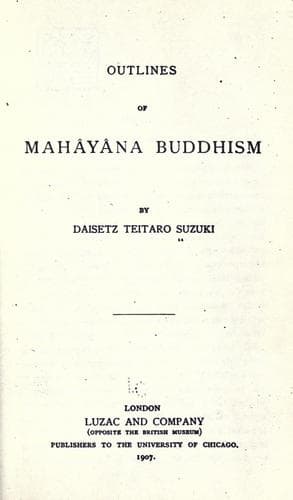
Outlines of Mahayana BuddhismSuzuki, Daisetz Teitaro
Religion
Outlines of Mahayana Buddhism
Suzuki, Daisetz Teitaro
Mahayana Buddhism -- Doctrines
These seven peculiarities are enumerated to be the reasons why the
doctrine defended by the progressive Buddhists is to be called
Mahâyânism, or the doctrine of great vehicle, in contradistinction to
Hînayânism, the doctrine of small vehicle. In each case, therefore,
Asanga takes pains to draw the line of demarcation distinctly between
the two schools of Buddhism and not between Buddhism and all other
religious doctrines which existed at his time.
_The Ten Essential Features of Buddhism._
The following statement of the ten essential features of Mahâyânism as
presented in the _Comprehensive Treatise on Mahâyânism_, is made from
a different standpoint from the preceding one, for it is the
pronunciamento of the Yogâcâra school of Asanga {66} and Vasubandhu
rather than that of Mahâyânism generally. This school together with
the Mâdhyamika school of Nâgârjuna constitute the two divisions of
Hindu Mahâyânism.[28]
The points enumerated by Asanga and Vasubandhu as most essential in
their system are ten.
(1) It teaches an immanent existence of all things in the
_Âlayavijñâna_ or All-Conserving Soul. The conception of an
All-Conserving Soul, it is claimed, was suggested by Buddha in the
so-called Hînayâna sûtras; but on account of its deep meaning and
of the liability of its being confounded with the ego-soul conception,
he did not disclose its full significance in their sûtras; but made
it known only in the Mahâyâna sûtras.
According to the Yogâcâra school, the Âlaya is not an universal, but
an individual mind or soul, whatever we may term it, in which the
“germs” of all things exist in their ideality.[29] The objective
world in reality does not exist, but by dint of subjective {67}
illusion that is created by ignorance, we project all these “germs” in
the Âlayavijñâna to the outside world, and imagine that they are
there really as they are; while the Manovijñâna (ego-consciousness)
which is too a product of illusion, tenaciously clinging to the
Âlayavijñâna as the real self, never abandons its egoism. The
Âlayavijñâna, however, is indifferent to, and irresponsible for, all
these errors on the part of the Manovijñâna.[30]
(2) The Yogâcâra school distinguishes three kinds of knowledge: 1.
Illusion (_parikalpita_), 2. Discriminative or Relative Knowledge
(_paratantra_), and 3. Perfect Knowledge (_pariniṣpanna_).
The distinction may best be illustrated by the well-known analogy of a
rope and a snake. Deceived by a similarity in appearance, men
frequently take a rope lying on the ground for a poisonous snake and
{68} are terribly shocked on that account. But when they approach and
carefully examine it, they become at once convinced of the
groundlessness of this apprehension, which was the natural sequence of
illusion. This may be considered to correspond to what Kant calls
_Schein_.
Public-domain text, read in full here on John Shaqi.
Reviews
Reviews
No reviews yet
Be the first to share your thoughts on this work.
Join the Discussion
Join the discussion
Sign in to leave a comment or review.
Sign InorCreate an account