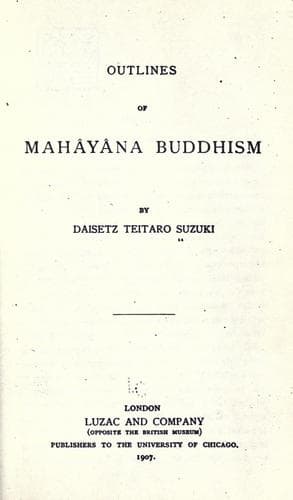
Outlines of Mahayana BuddhismSuzuki, Daisetz Teitaro
Religion
Outlines of Mahayana Buddhism
Suzuki, Daisetz Teitaro
Mahayana Buddhism -- Doctrines
Most people, however, do not go any further in their inquiry. They are
contented with the sensual, empirical knowledge of an object with
which they come in contact. When they understand that the thing they
mistook for a snake was really nothing but a yard of innocent rope,
they think their knowledge of the object is complete, and do not
trouble themselves with a philosophical investigation as to whether
the rope which to them is just what it appears to be, has any real
existence in itself. They do not stop a moment to reflect that their
knowledge is merely relative, for it does not go beyond the phenomenal
significance of the things they perceive.
But is an object in reality such as it appears to be to our senses?
Are particular phenomena as such really actual? What is the value of
our knowledge concerning those so-called realities? When we make an
investigation into such problems as these, the Yogâcâra school says,
we find that their existence is only relative and has no absolute
value whatever independent of the perceiving subject. They are the
“ejection” of our ideas into the outside world, which are centred and
conserved in our Âlayavijñâna and which are awakened into activity by
subjective {69} ignorance. This clear insight into the nature of
things, i.e., into their non-realness as âtman, constitutes perfect
knowledge.
(3) When we attain to the perfect knowledge, we recognise the ideality
of the universe. There is no such thing as an objective world, which
is really an illusive manifestation of the mind called Âlayavijñâna.
But even this supposedly real existence of the Âlayavijñâna is a
product of particularisation called forth by the ignorant Manovijñâna.
The Manovijñâna, or empirical ego, as it might be called, having no
adequate knowledge as to the true nature of the Âlaya, takes the latter
for a metaphysical agent, that like the master of a puppet-show manages
all mental operations according to its humour. As the silkworm
imprisons itself in the cocoon created by itself, the Manovijñâna,
entangling itself in ignorance and confusion, takes its own illusory
creations for real realities.
Public-domain text, read in full here on John Shaqi.
Reviews
Reviews
No reviews yet
Be the first to share your thoughts on this work.
Join the Discussion
Join the discussion
Sign in to leave a comment or review.
Sign InorCreate an account