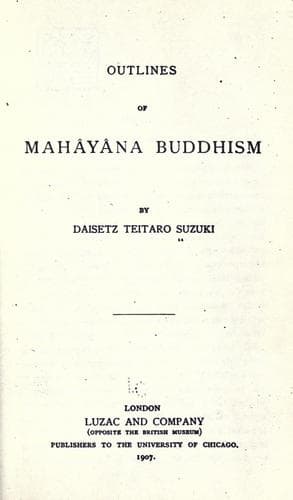
Outlines of Mahayana BuddhismSuzuki, Daisetz Teitaro
Religion
Outlines of Mahayana Buddhism
Suzuki, Daisetz Teitaro
Mahayana Buddhism -- Doctrines
From these statements it will be apparent that the emptiness of things
(_çûnyatâ_) does not mean nothingness, as is sometimes interpreted
by some critics, but it simply means conditionality or transitoriness
of all phenomenal existences, it is a synonym for aniyata or pratîtya.
Therefore, emptiness, according to the Buddhists, signifies,
negatively, the absence of particularity, the non-existence of
individuals as such, and positively, the ever-changing state of the
phenomenal world, a constant flux of becoming, an eternal series of
causes and effects. It must never be understood in the sense of
annihilation or absolute nothingness, for nihilism is as much
condemned by Buddhism as naïve realism. “The Buddha proclaimed
emptiness as a remedy for all doctrinal controversies, but those who
in turn cling to emptiness are beyond treatment.” A medicine is
indispensable as long as there is a disease to heal, but it turns
poisonous when applied after the restoration of perfect health. To
make this point completely clear, let me quote the following from
Nâgârjuna’s _Mâdhyamika Çâstra_ (Chap. XXIV). “[Some one may object to
the Buddhist doctrine of emptiness, declaring:] If all is void
(_çûnya_) and {174} there is neither creation nor destruction, then it
must be concluded that even the Fourfold Noble Truth does not exist.
If the Fourfold Noble Truth does not exist, the recognition of
Suffering, the stoppage of Accumulation, the attainment of Cessation,
and the advancement of Discipline,--all must be said to be
unrealisable. If they are altogether unrealisable, there cannot be any
of the four states of saintliness; and without these states there
cannot be anybody who will aspire for them. If there are no wise men,
the Sangha is then impossible. Further, as there is no Fourfold Noble
Truth, there is no Good Law (_saddharma_); and as there is neither
Good Law nor Sangha, the existence of Buddha himself must be an
impossibility. Those who talk of emptiness, therefore, must be said to
negate the Triple Treasure (_triratna_) altogether. Emptiness not only
destroys the law of causation and the general principle of retribution
(_phalasadbhâvam_), but utterly annihilates the possibility of a
phenomenal world.”
“[To this it is to be remarked that]
“Only he is annoyed over such scepticism who understands not the true
significance and interpretation of emptiness (_çûnyatâ_).
“The Buddha’s teaching rests on the discrimination of two kinds of
truth (_satya_): absolute and relative. Those who do not have any
adequate knowledge of them are unable to grasp the deep and subtle
meaning of Buddhism. [The essence of being, dharmata, is beyond verbal
definition or intellectual comprehension, {175} for there is neither
birth nor death in it, and it is even like unto Nirvâna. The nature
of Suchness, tattva, is fundamentally free from conditionality, it is
tranquil, it distances all phenomenal frivolities, it discriminates
not, nor is it particularised].[83]
Public-domain text, read in full here on John Shaqi.
Reviews
Reviews
No reviews yet
Be the first to share your thoughts on this work.
Elsewhere in the archive
Join the Discussion
Join the discussion
Sign in to leave a comment or review.
Sign InorCreate an account