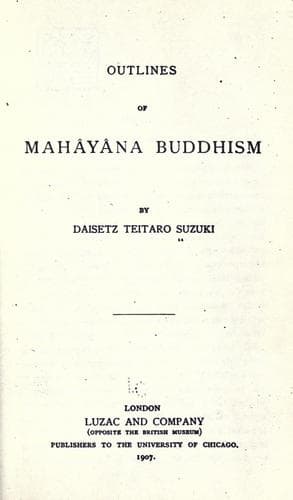
Outlines of Mahayana BuddhismSuzuki, Daisetz Teitaro
Religion
Outlines of Mahayana Buddhism
Suzuki, Daisetz Teitaro
Mahayana Buddhism -- Doctrines
“But if not for relative truth, absolute truth is unattainable, and
when absolute truth is not attained, Nirvâna is not to be gained.
“The dull-headed who do not perceive the truth rightfully go to
self-destruction, for they are like an awkward magician whose trick
entangles himself, or like an unskilled snake-catcher who gets himself
hurt. The World-honored One knew well the abstruseness of the Doctrine
which is beyond the mental capacity of the multitudes and was inclined
not to disclose it before them.
“The objection that Buddhism onesidedly adheres to emptiness and
thereby exposes itself to grave errors, entirely misses the mark; for
there are no errors in emptiness. Why? Because it is on account of
emptiness that all things are at all possible, and without emptiness
all things will come to naught. Those who deny emptiness and find
fault with it, are like a horseman who forgets that he is on
horseback.
“If they think that things exist because of their self-essence
(_svabhâva_), [and not because of their emptiness,] they thereby make
things come out of causelessness (_ahetupratyaya_), they destroy those
{176} relations that exist between the acting and the act and the
acted; and they also destroy the conditions that make up the law of
birth and death.
“All is declared empty because there is nothing that is not a product
of universal causation (_pratyayasamutpâda_). This law of causation,
however, is merely provisional, though herein lies the middle path.
“As thus there is not an object (_dharma_) which is not conditioned
(_pratîtya_), so there is nothing that is not empty.
“If all is not empty, then there is no death nor birth, and withal
disappears the Fourfold Noble Truth.
“How could there be Suffering, if not for the law of causation?
Impermanence is suffering. But with self-essence there will be no
impermanence. [So long as impermanence is the condition of life,
self-essence which is a causeless existence, is out of question.]
Suppose Suffering is self-existent, then it could not come from
Accumulation, which in turn becomes impossible when emptiness is not
admitted. Again, when Suffering is self-existent, then there could be
no Cessation, for with the hypothesis of self-essence Cessation
becomes a meaningless term. Again, when Suffering is self-existent,
then there will be no Path. But as we can actually walk on the Path,
the hypothesis of self-essence is to be abandoned.
“If there is neither Suffering nor Cessation, it must be said that the
Path leading to the Cessation of Suffering is also non-existent.
Public-domain text, read in full here on John Shaqi.
Reviews
Reviews
No reviews yet
Be the first to share your thoughts on this work.
Elsewhere in the archive
Join the Discussion
Join the discussion
Sign in to leave a comment or review.
Sign InorCreate an account