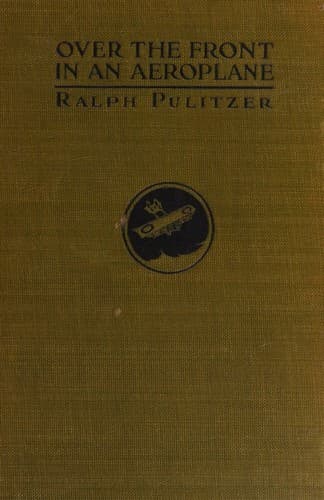
Over the Front in an Aeroplane, and Scenes Inside the French and Flemish Trenches — John Shaqi
Over the Front in an Aeroplane, and Scenes Inside the French and Flemish TrenchesPulitzer, Ralph
History
Over the Front in an Aeroplane, and Scenes Inside the French and Flemish Trenches
Pulitzer, Ralph
World War, 1914-1918 -- Personal narratives
The activities of war correspondents have been thoroughly regulated,
systematized, standardized. Just what the correspondent is to be
permitted to see at the front is deliberately considered and arranged
in advance. The authorities decide what fights are fit for him to see
just as painstakingly as chaperons used to decide what plays were
fit for débutantes to see. He, together with the six or eight other
journalists who are to make up the party, is placed in the hands of a
military duenna who guards his every move from the time the admirably
organized tour starts, until he is again safely delivered back in
Paris. The precise duration of the trip, the precise route to be taken,
the precise place at which each meal is to be eaten, the precise room
in the precise hotel in which each night is to be spent, the precise
General to be met and trench to be visited, are all inexorably fixed in
the schedule of the trip.
The only phenomena which the general staffs cannot predetermine are
the activities of the aviators and the course of the enemy's shells
and bullets. Hence, the only spontaneous adventures in store for
correspondents, which may come unexpectedly, at any moment, are the
whirring of aeroplanes overhead, their shelling and their duels and the
sudden passing or arrival of enemy projectiles, from tiny bullets up to
enormous "Jack Johnsons."
Even this element of surprise can be avoided in the case of a
small minority of visitors who I understand prefer to limit their
researches at "the front" to the hospitals, supply-trains, motor-repair
organizations, encampments of reserves, and similar objects of
interest, which lie some twenty kilometres behind the trenches and yet
really are sufficiently a part of the front to be known as its rear.
The front has a second category of visitors besides the war
correspondents of whom I have been writing--"the distinguished
strangers." These do not come to the front for the purpose of writing
about what they see, and are for this reason, as well as because of the
courtesy which it is desired to show them, allowed considerably more
latitude, although they, too, are kept religiously away from any part
of the lines where real trouble is expected.
I myself was fortunate enough to be invited to visit the French and
Belgian fronts in a sort of dual capacity. Having pledged myself not to
go on to Germany, and to write nothing about anything that was shown me
in confidence, I was given a special trip, instead of going with one of
the regular "journalists' parties," which certainly have an unromantic
resemblance to Cook's Tours. I was thus enabled to visit certain
advanced trenches where larger parties, in the nature of things, could
not go, and was shown things which had not previously been shown to
correspondents. But the organization of my trip resembled that of the
average correspondents' tour closely enough to enable me to describe
its details.
* * * * *
Public-domain text, read in full here on John Shaqi.
Reviews
Reviews
No reviews yet
Be the first to share your thoughts on this work.
Join the Discussion
Join the discussion
Sign in to leave a comment or review.
Sign InorCreate an account