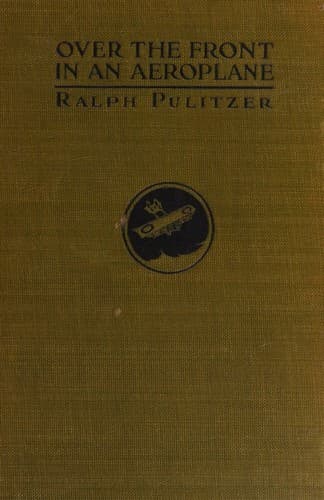
Over the Front in an Aeroplane, and Scenes Inside the French and Flemish TrenchesPulitzer, Ralph
History
Over the Front in an Aeroplane, and Scenes Inside the French and Flemish Trenches
Pulitzer, Ralph
World War, 1914-1918 -- Personal narratives
The war correspondent does not buy himself a motor, because if he did
he would not be allowed to use it. All he buys himself is a railway
ticket. When it comes to motoring, he is packed with an assortment of
fellow-correspondents into military autos specially assigned by the
army authorities.
He does not buy a shelter-tent or a sleeping-bag, because at a certain
scheduled hour every evening the staff-officer who has him and his
colleagues in tow will lead him into an excellent hotel in some large
town or other and assign him to a comfortable bedroom engaged ahead. He
does not buy canned provisions, because before going to bed the officer
buys him an appetizing dinner, follows it up with a good breakfast the
next morning, and at lunch-time introduces him to a courteous General,
or, at a pinch, to another hotel-keeper, by one or the other of whom
he is supplied with a prearranged and excellent lunch.
He does not buy himself a medicine-chest, because he is always within
shouting distance of enough medical talent to treat a whole city.
He does not buy a revolver, because it would be gently but firmly taken
away from him if he did.
If he is sensible, he does not even buy himself binoculars, for the
officers by whom he will find himself uninterruptedly accompanied
will be glad to let him use theirs, and though he may not look so
picturesque without them, he will be much more comfortable if he has
any hands-and-knees work to do.
Finally, he will not have a word to say as to where he wants to go or
what he wants to see, for that has all been settled in advance.
It is true that different Generals vary greatly in the risks that they
will allow correspondents to run with their respective armies. Some
feel that if a correspondent wants to take chances that is his own
affair so long as he does not unduly endanger the life of a valuable
staff-officer along with his own. Others feel personally responsible
for the safeguarding of visitors, whether the visitor is willing to
take chances or not.
But these variations merely affect the more or less dangerous details
of the trip, not the programme as a whole, which is quite rigid.
In the beginning of the war a few men, like Alexander Powell in
Flanders, and Robert Dunn in the retreat from Mons, were actual
knights-errant of the pen and wandered or whirled where they pleased,
and saw what happened to come their way.
But on the western front, at least, that is all dead and gone.
Public-domain text, read in full here on John Shaqi.
Reviews
Reviews
No reviews yet
Be the first to share your thoughts on this work.
Join the Discussion
Join the discussion
Sign in to leave a comment or review.
Sign InorCreate an account