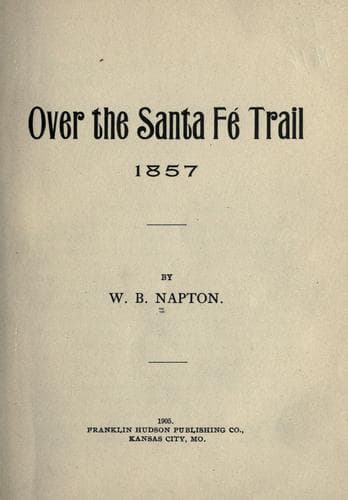
Over the Santa Fé Trail, 1857Napton, William Barclay
History
Over the Santa Fé Trail, 1857
Napton, William Barclay
Santa Fe National Historic Trail
No great harm resulted from the stampede. Some others of the party of
Indians ran ahead and stopped the cattle. There was no collision of
wagons and no damage, but the affair left an ugly feeling of resentment
among the teamsters toward the Indians. The Indians laughed and talked
about the affair among themselves. Any effort to punish them was
out of the question, the entire tribes of Kiowas and Comanches being
encamped within a day’s journey above us.
[Illustration: THE MULE SUDDENLY BUCKED.]
The Indians kept along with the train all of the afternoon. Observing
my horse and accoutrements, they inquired through Juan, the Spaniard,
if he was fleet and good for buffalo, and pressed me to go out with
them for buffalo the next day. I would gladly have seen the Indians
engaged in a buffalo chase, but declined the invitation, making such
excuses as I could without expressing any want of confidence as to
their good fellowship. My scalp was intact and I felt disposed to keep
it so.
The Kiowas begged Captain Chiles and Hagan to give them some flour and
sugar, but they refused, knowing that a donation would be necessary
later on, when we should meet the entire tribes of Kiowas and Comanches
encamped above us, awaiting the arrival of their agent and the train
load of goods for them.
Late in the evening, after we had corralled and the cooks were
preparing to get supper these Indians having ridden off in the
direction of the river, two of them reappeared. They returned to the
camp, each with a bundle of dry driftwood, picked up on the river bank,
which they threw down near the camp fire. This meant that they wanted
supper, and Captain Chiles gave directions for the preparation of food
for them. The Indians took supper with us, after which they departed,
evidently feeling better and good naturedly disposed toward us.
That night there was much discussion of the Indian problem, with which
we seemed now confronted. At noon the next day, as the cattle were
being driven into the corral, another party of young warriors made
their appearance at our camp, and came near involving us in a serious
conflict. The trouble was brought on by the impatient action of our
assistant wagonmaster, Rice. Four or five young fellows rode up into
the rear entrance of our corral and were sitting there on their horses
looking on at the yoking of the cattle. They partially blocked up the
opening and interfered with egress of the teams. Rice, coming up behind
them, without warning gave one of their horses a blow with a heavy
blacksnake whip. The horse sprang forward, nearly unseating the rider,
who, as soon as he could gather up the reins of his bridle, turned upon
Rice in a towering rage, jerked an arrow from its quiver and fixed it
in his bow. Forcing his horse right upon Rice, the Indian punched him
with the point of the arrow until he knocked his hat off his head. Rice
made no effort to resist the affront and threatened assault, but kept
backing out of the Indian’s reach.
Public-domain text, read in full here on John Shaqi.
Reviews
Reviews
No reviews yet
Be the first to share your thoughts on this work.
Join the Discussion
Join the discussion
Sign in to leave a comment or review.
Sign InorCreate an account