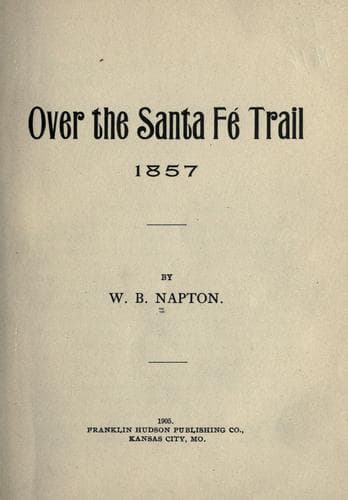
Over the Santa Fé Trail, 1857Napton, William Barclay
History
Over the Santa Fé Trail, 1857
Napton, William Barclay
Santa Fe National Historic Trail
Riding thus alone on one occasion, some distance ahead of the train,
I saw a large gray wolf galloping across my course, going towards the
road. I determined to give him a chase, and after him I went. The wolf
increased his speed, and, urging my horse to his best, we went flying
across the road 100 yards in front of the train and in full view of it.
As we flew by, the entire company of teamsters gave us an encouraging
whoop, but whether designed for me or the wolf I was not able to
determine. I had followed the big fellow closely for a mile, emptying
at him, if not in him, the entire twelve chambers of my revolvers. At
one time I got within twenty feet of him, but not having any ammunition
for reloading with me, nor time for recharging my pistols if I had, he
disappeared over the ridge and I saw nothing more of him.
Many days passed and many weary miles were traveled of which I have no
remembrance whatever and I am only attempting to relate such adventures
as were indelibly impressed upon my memory, the frosts of forty-three
winters having passed over my head since this journey was made. I
cannot recollect what I thought of the probability of those vast
plains ever being occupied or cultivated as homes for white people.
Whetstone creek, which the road crossed near the boundary of New
Mexico, was one of the localities of special interest to me. Back on my
father’s farm in Missouri I had often whetted my pocketknife on a stone
belonging to my old overseer friend who said he had obtained it on this
creek. But none of our trainmen were familiar with the route or the
locality, or could tell me where the whetstone quarry was to be found,
and I was disappointed in not being able to discover it after making a
diligent search for it. And now the spurs of the Raton mountains loomed
up in the distance ahead of us, a novel and interesting sight to many
of the company, some of whom had never seen any greater elevation than
the big hills of Western Missouri, and the drivers swore and cracked
their whips with renewed vigor and animation.
XI.
ARRIVAL AT LAS VEGAS.
Crossing the Ocata on the dry bed of it we were approaching Apache
hill, on the branch of the road leading to Fort Union, the ascent of
which was quite difficult to heavily loaded wagons. The hill was barely
visible in the distance and the hour nearly noon when we first came
in sight of it. It was quite hot under the noonday sun and we could
see the white sheets of a train of wagons descending the hill. Soon
afterwards Captain Chiles and I, riding ahead of our train, met the
wagonmaster of this train, a sandy-haired, red-faced fellow, sullen,
morose and non-communicative. He seemed inclined to pass us without
speaking, but Captain Chiles saluted him, and he halted for a few
moments. The man appeared to be sick, and as Captain Chiles afterwards
said he could scarcely “pull a word out of him with a log chain.”
Public-domain text, read in full here on John Shaqi.
Reviews
Reviews
No reviews yet
Be the first to share your thoughts on this work.
Join the Discussion
Join the discussion
Sign in to leave a comment or review.
Sign InorCreate an account