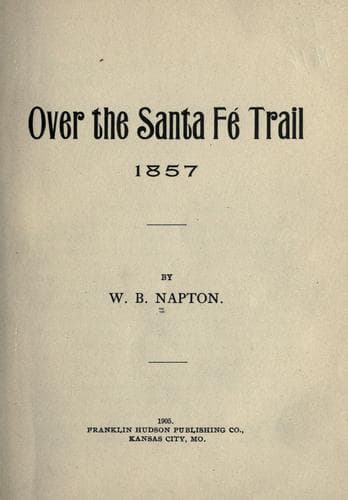
Over the Santa Fé Trail, 1857Napton, William Barclay
History
Over the Santa Fé Trail, 1857
Napton, William Barclay
Santa Fe National Historic Trail
Young Reece, from Missouri, went out with the train for his health.
He had consumption and hoped the journey over the plains would be of
benefit to him. He was very tall, being six feet four inches, of large
bone and frame, but thin as a huge skeleton, and had allowed his heavy
black hair to grow until it hung below his shoulders. He was well off
so far as property was concerned, and rode a splendid dapple gray
horse, muscular, tough and graceful, with handsome mane and tail, which
could fairly fly over the prairie.
II.
IN CAMP, SOUTH OF WESTPORT.
In the camp, three miles southwest of Westport, we were detained for a
fortnight or more, awaiting the arrival of our freight at Kansas City.
There were twenty-six wagon, five yoke of oxen to each, carrying about
seven thousand pounds of freight each. There were no tents, so we slept
on the ground, either under a wagon or, if we preferred it, the broad
canopy of heaven.
Captain “Jim Crow” commanded the company, with Rice as assistant
wagonmaster. There was one driver for each wagon, and a boy of 16, of
frontier origin and training, whose duty it was to drive the “cavayard”
or loose cattle, taken along in case any of the teams should get lame
or unfit for service. “Jim Crow,” immediately on his arrival at the
camp, gave the boy the nickname of “Little Breeches,” suggested by
his very tight-fitting trousers, and the name, abbreviated to “Little
Breech,” stuck to him.
While encamped below Westport I was fortunate in purchasing a first
rate “buffalo horse,” a California “lass horse,” that had been
brought across the plains the previous year. He proved his excellence
afterward, was very fast and would run up so close to a buffalo that I
could sometimes touch him with the pistol point.
Camped in our vicinity were several corrals of trains belonging to
Mexican merchants, who used mules instead of oxen, and had lately
come up from New Mexico. These Mexicans subsisted altogether on taos
(unbolted) flour, and dried buffalo meat, while our mess wagon was
filled with side bacon, flour, coffee, sugar, beans and pickles.
I soon got on fair terms of acquaintance with the master of one of
these Spanish trains. He was a successful buffalo hunter, but I was
surprised to find he used a spear for killing them, instead of a
pistol. When a buffalo was found at a distance from the road or camp he
would goad the animal, until so enraged, it would turn upon and follow
him, and in this manner he would get the game to a more convenient
place for butchering, before finally dispatching it.
There were no farms fenced up in sight of our camp at that time, but
the prairie was dotted with the houses of the “squatter sovereigns,”
who were “holding down” claims.
Public-domain text, read in full here on John Shaqi.
Reviews
Reviews
No reviews yet
Be the first to share your thoughts on this work.
Join the Discussion
Join the discussion
Sign in to leave a comment or review.
Sign InorCreate an account