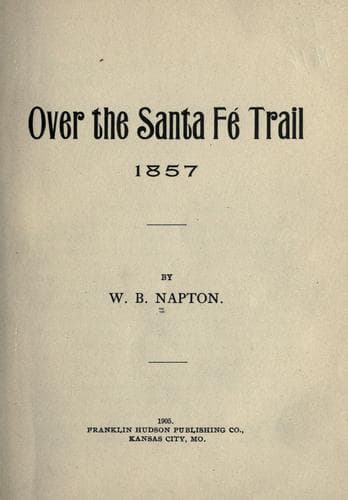
Over the Santa Fé Trail, 1857Napton, William Barclay
History
Over the Santa Fé Trail, 1857
Napton, William Barclay
Santa Fe National Historic Trail
On the 10th day of June we yoked up and started on the long journey. At
the outset everybody about the train, from the captain to the cavayard
driver, was filled with good humor. The weather was perfect, the view
of the apparently boundless prairie exhilarating. The road having been
surveyed and established by the government before the country was at
all occupied, was almost as straight as an arrow toward the southwest.
The wagonmaster would arouse the men before daylight in the morning and
the cattle would be driven up to the corral, yoked up and hitched to
the wagons by the time the cooks could prepare breakfast, a cook being
assigned to each mess of six or eight men. Some of the oxen were not
well broken to the yoke, and it was a difficult task at the dim break
of day for a green man to select each steer that belonged to his team
in the corral, where the 250 were crowded together so that their sides
would almost touch.
Once on the road the drive was continued for from eight to twelve
miles, the stops being governed by the convenience of camping-places,
where grass and water could be found for the cattle. Familiarity with
the route was essential in the wagonmaster, who, riding some distance
ahead, would select the camping-place, and when the train came up
direct the formation of the corral. The cattle were immediately
unyoked and turned loose, herded by two of the teamsters. Often it was
necessary to drive the cattle a mile or more from the corral in order
to find sufficient grass, that near the road being kept short by the
incoming trains from Mexico and the outgoing trains ahead of us.
At Council Grove there was a considerable settlement of Indian traders.
There we found assembled a large band of Kaw Indians, who had just
reached there from a buffalo hunt on the Arkansas. The Kaws were
not classed as “wild” Indians, and I think had been assigned to a
reservation not far off, but when they got off on a hunt their native
savage inclinations made them about as dangerous as those roaming the
plains at will, and whose contact with the white man was much less
frequent.
Public-domain text, read in full here on John Shaqi.
Reviews
Reviews
No reviews yet
Be the first to share your thoughts on this work.
Join the Discussion
Join the discussion
Sign in to leave a comment or review.
Sign InorCreate an account