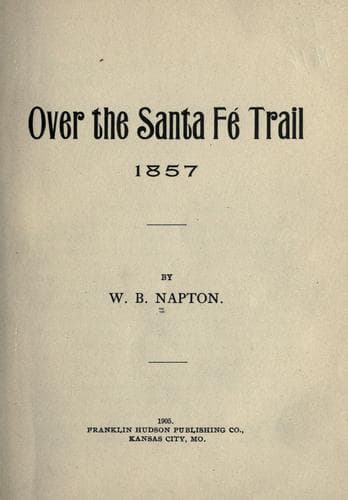
Over the Santa Fé Trail, 1857Napton, William Barclay
History
Over the Santa Fé Trail, 1857
Napton, William Barclay
Santa Fe National Historic Trail
At the outset I was more fortunate than on the previous day, for when
I had gotten up close to them I found in front of me cows and calves,
young things of one or two years old. Singling out a fat young cow,
distinguished by her glossy coat of hair, I forced my horse right up
against her and brought her down at the second shot. I pulled rein,
stopping my horse as suddenly as was possible at the breakneck speed
at which he was going, and in another moment the herd had spread out,
and I was completely surrounded by the rushing mass of animals which my
attack had set in motion.
The air was so clouded with dust that I could hardly see more than
twenty yards from where I was standing, near the carcass of the cow
I had killed. There was danger of being run over by them, but they
separated as they approached, passing on either side of me, a few yards
distant. After a while the rushing crowd thinned, and up rode Captain
Chiles exclaiming: “Why don’t you kill another?”
Fifty yards from us they were rushing by, all in the same direction.
I again dashed into the midst of them, pressing my horse in pursuit
of another young cow. She shot ahead of everything, increasing her
speed so that I could hardly keep sight of her. While thus running at
full speed my horse struck a calf with his breast, knocking the calf
down flat, and almost throwing himself also. I pulled up as quickly as
possible, turned around and shot the prostrate calf before it could
get up. So I had two dead in, say twenty minutes. After this day’s
experience I had no trouble in killing all the buffalo we needed for
our own consumption. For a week or ten days they were hardly out of
sight. We found them as far west as Pawnee Rock. All told, I killed
about twenty on the journey out and back. A good steak, cut from the
loin of a buffalo cow, broiled on the coals with a thin slice of bacon
attached to it to improve its flavor, was “good eating,” and I soon
became an accomplished broiler.
IV.
COMPANIONS OF VOYAGE.
Before reaching Pawnee Rock we overtook a train of thirty wagons
belonging to the leading freighters of the West, Majors, Russell &
Waddell, with which we traveled to Fort Union, their freight being
consigned to that post. This train had thirty wagons, built, I
believe, in Philadelphia, with heavy iron axles and spindles, which
seemed superior to any others I had seen on the prairies. Hagan was
wagonmaster and Hines his assistant. The former was a sandy-haired man,
who rode a large bay mule, a drowsy animal with immense lop ears that
moved back and forth as he walked. This ungainly mule, I found out, in
a day or two afterwards, had his good points. He could run as fast and
get up as close to a buffalo as any horse in either outfit.
Public-domain text, read in full here on John Shaqi.
Reviews
Reviews
No reviews yet
Be the first to share your thoughts on this work.
Join the Discussion
Join the discussion
Sign in to leave a comment or review.
Sign InorCreate an account