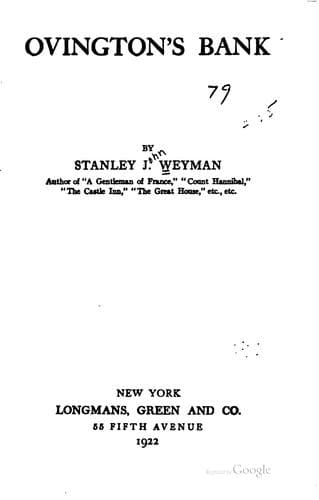
Banks and banking -- Fiction; England -- Social life and customs -- 19th century -- Fiction; Love stories
“No!” she protested. “And I don’t think that it has always been so with
us.” Then, collecting herself and in a firmer voice, “No, Arthur, not
lately, I am sure. I don’t think that it has been so on your side—I
don’t, indeed. And I’m sure that I have not thought of this myself.”
“Jos!”
“No, Arthur, I have not, indeed.”
“You haven’t seen that I loved you?”
“No. And,” looking him steadily in the face, “I am not sure that you
do.”
“Then let me tell you that I do. I do!” And he tried to possess himself
of her other hand, and there was a little struggle between them. “Dear,
dear girl, I do love you,” he swore. “And I want you, I want you for my
wife. And your father permits it. Do you understand—I don’t think you
do? He sanctions it.”
He would have put his arm round her, thinking to overcome her
bashfulness, thinking that this was but maidenly pride, waiting to be
conquered. But she freed herself with unexpected vigor and slipped from
him. “No, I don’t wish it!” she said. And her attitude and her tone
were so resolute, that he could no longer deceive himself. “No! Listen,
Arthur.” She was pale, but there was a surprising firmness in her face.
“Listen! I do not believe that you love me. You have given me no cause
to think so these many months. Such a boy and girl affection as was
once between us might have grown into love in time, had you wished it.
But you did not seem to wish it, and it has not. What you feel is not
love.”
“You know so much about love!” he scoffed. He was taken aback, but he
tried to laugh—tried to pass it off.
But she did not give way. “I know what love is,” she answered firmly.
And then, without apparent cause, a burning blush rose to her very
hair. Yet, in defiance of this, she repeated her words. “I know what
love is, and I do not believe that you feel it for me. And I am sure,
quite sure, Arthur,” in a lower tone, “that I do not feel it for you. I
could not be your wife.”
“Jos!” he pleaded earnestly. “You are joking! Surely you are joking.”
“No, I am not joking. I do not wish to hurt you. I am grieved if I do
hurt you. But that is the truth. I do not want to marry you.”
He stared at her. At last she had compelled him to believe her, and he
reddened with anger; only to turn pale, a moment later, as a picture of
himself humiliated and rejected, his plans spoiled by the fancy of this
foolish girl, rose before him. He could not understand it; it seemed
incredible. And there must be some reason? Desperately he clutched at
the thought that she was afraid of her father. She had not grasped the
fact that the Squire had sanctioned his suit, and, controlling his
voice as well as he could, “Are you really in earnest, Jos?” he said.
“Do you understand that your father is willing? That it is indeed his
wish that we should marry?”
“I cannot help it.”
Public-domain text, read in full here on John Shaqi.
Reviews
Reviews
No reviews yet
Be the first to share your thoughts on this work.
Elsewhere in the archive
Join the Discussion
Join the discussion
Sign in to leave a comment or review.
Sign InorCreate an account