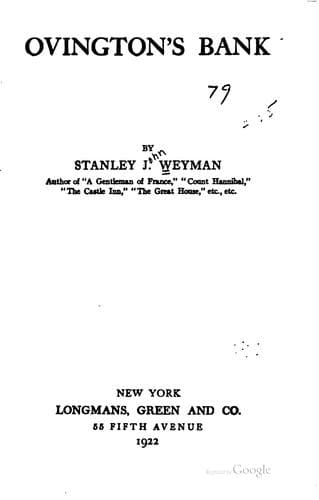
Banks and banking -- Fiction; England -- Social life and customs -- 19th century -- Fiction; Love stories
“But—love?” Though he tried to keep his temper his voice was growing
sharp. “What, after all, do you know of—love?” And rapidly his mind ran
over the possibilities. No, there could be no one else. She knew few,
and among them no one who could have courted her without his knowledge.
For, strange to say, no inkling of the meetings between Clement and his
cousin had reached him. They had all taken place within a few weeks,
they had ceased some months back, and though there were probably some
in the house who had seen things and drawn their conclusions, the
favorers of young love are many, and no one save Thomas had tried to
make mischief. No, there could be no one, he decided; it was just a
silly girl’s romantic notion. “And how can you say,” he continued,
“that mine is not real love? What do you know of it? Believe me, Jos,
you are playing with your happiness. And with mine.”
“I do not think so,” she answered gravely. “As to my own, I am sure,
Arthur. I do not love you and I cannot marry you.”
“And that is your answer?”
“Yes, it must be.”
He forced a laugh. “Well, it will be news for your father,” he said. “A
clever game you have played, Miss Jos! Never tell me that it is not in
women’s nature to play the coquette after this. Why, if I had treated
you as you have treated me—and made a fool of me! Made a fool of me!”
he reiterated passionately, unable to control his chagrin—“I should
deserve to be whipped!”
And afraid that he would break down before her and disgrace his
manhood, he turned about, sprang down the steps and savagely spurning,
savagely trampling under foot the shrivelled leaves, he strode across
the garden to the house. “The little fool!” he muttered, and he
clenched his hands as if he could have crushed her within them. “The
little fool!”
He was angry, he was very angry, for hitherto fortune had spoiled him.
He had been successful, as men with a single aim usually are
successful. He had attained to most of the things which he had desired.
Now to fail where he had deemed himself most sure, to be repulsed where
he had fancied that he had only to stoop, to be scorned where he had
thought that he had but to throw the handkerchief, to be rejected and
rejected by Jos—it was enough to make any man angry, to make any man
grind his teeth and swear! And how—how in the world was he to explain
the matter to his uncle? How account to him for his confidence in the
issue? His cheeks burned as he thought of it.
Public-domain text, read in full here on John Shaqi.
Reviews
Reviews
No reviews yet
Be the first to share your thoughts on this work.
Elsewhere in the archive
Join the Discussion
Join the discussion
Sign in to leave a comment or review.
Sign InorCreate an account