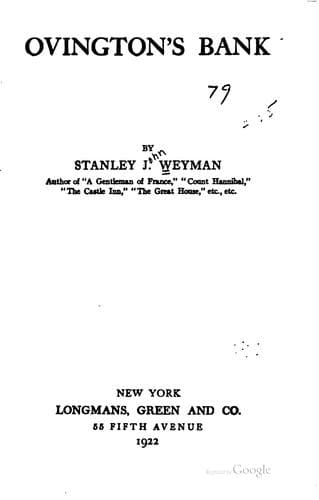
Banks and banking -- Fiction; England -- Social life and customs -- 19th century -- Fiction; Love stories
He was angry. But his wrath was no match for the disappointment that
warred with it and presently, as passion waned, overcame it. He had to
face and to weigh the consequences. The loss of Jos meant much more
than the loss of a mild and biddable wife with a certain charm of her
own. It meant the loss of Garth, of the influence that belonged to it,
the importance that flowed from it, the position it conferred. It meant
the loss of a thing which he had come to consider as his own. The
caprice of this obstinate girl robbed him of that which he had bought
by a long servitude, by much patience, by many a tiresome ride between
town and country!
There, in that loss, was the true pinch! But he must think of it. He
must take time to review the position and consider how he might deal
with it. It might be that all was not yet lost—even at Garth.
In the meantime he avoided seeing his uncle, and muttering a word to
Miss Peacock, he had his horse saddled. He mounted in the yard and
descended the drive at his usual pace. But as soon as he had gained the
road, he lashed his nag into a canter, and set his face for town. At
worst the bank remained, and he must see that it did remain. He must
not let himself be scared by Ovington’s alarms. If a crisis came he
must tackle the business as he alone could tackle business, and all
would be well. He was sure of it.
Withal he was spared one pang, the pang of disappointed love.
CHAPTER XXIV
Arthur was at the bank by noon, and up to that time nothing had
occurred to justify the banker’s apprehensions or to alarm the most
timid. Business seemed to be a little slack, the bank door had a rest,
and there was less coming and going. But in the main things appeared to
be moving as usual, and Arthur, standing at his desk in an atmosphere
as far removed as possible from that of Garth, had time to review the
check that he had received at Josina’s hands, and to consider whether,
with the Squire’s help, it might not still be repaired.
But an hour or two later a thing occurred which might have passed
unnoticed at another time, but on that day had a meaning for three out
of the five in the bank. The door opened a little more abruptly than
usual, a man pushed his way in. He was a publican in a fair way of
business in the town, a smug ruddy-gilled man who, in his younger days,
had been a pugilist at Birmingham and still ran a cock-pit behind the
Spotted Dog, between the Foregate and the river. He stepped to the
counter, his small shrewd eyes roving slyly from one to another.
Arthur went forward to attend to him. “What is it, Mr. Brownjohn?” he
asked. But already his suspicions were aroused.
“Well, sir,” the man answered bluntly, “what we most of us want, sir.
The rhino!”
“Then you’ve come to the right shop for that,” Arthur rejoined, falling
into his humor. “How much?”
“How’s my account, sir?”
Public-domain text, read in full here on John Shaqi.
Reviews
Reviews
No reviews yet
Be the first to share your thoughts on this work.
Elsewhere in the archive
Join the Discussion
Join the discussion
Sign in to leave a comment or review.
Sign InorCreate an account