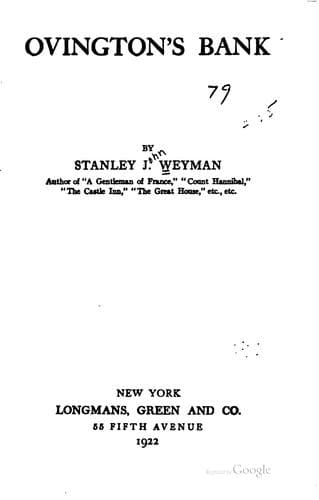
Banks and banking -- Fiction; England -- Social life and customs -- 19th century -- Fiction; Love stories
Arthur consulted the book which he took from a ledge below the counter.
In our time he would have scribbled the sum on a scrap of paper and
passed the paper over in silence. But in those days many customers
would have been none the wiser for that, for they could not read. So,
“One, four, two, and three and six-pence,” he said.
“Well, I’ll take it,” the publican announced, gazing straight before
him.
Arthur understood, but not a muscle of his face betrayed his knowledge.
“Brewers’ day?” he said lightly. “Mr. Rodd, draw a cheque for Mr.
Brownjohn. One four two, three and six. Better leave five pounds to
keep the account open?”
“Oh, well!” Mr. Brownjohn was a little taken aback. “Yes, sir, very
well.”
“One three seven, Rodd, three and six.” And while the customer,
laboriously and with a crimsoning face, scrawled his signature on the
cheque, Arthur opened a drawer and counted out the amount in Ovington’s
notes. “Twenty-seven fives, and two, three, six,” he muttered, pushing
it over. “You’ll find that right, I think.”
Brownjohn had had his lesson from Wolley, who put up at his house, but
he had not learnt it perfectly. He took the notes, and thumbed them
over, wetting his thumb as he turned each, and he found the tale
correct. “Much obliged, gentlemen,” he muttered, and with a perspiring
brow he effected his retreat. Already he doubted—so willingly had his
money been paid—if he had been wise. He was glad that he had left the
five pounds.
But the door had hardly closed on him before Arthur asked the cashier
how much gold he had in the cash drawer.
“The usual, sir. One hundred and fifty and thirty-two, thirty-three,
thirty-four—one hundred and eighty-four.”
“Fetch up two hundred more before Mr. Brownjohn comes back,” Arthur
said. “Don’t lose time.”
Rodd did not like Arthur, but he did silent homage to his sharpness. He
hastened to the safe and was back in two minutes with twenty rouleaux
of sovereigns. “Shall I break them, sir?” he asked.
“Yes, I think so. Ah!” as the door swung open and one of the Welsh
brothers entered. It was Mr. Frederick. Arthur nodded. “Good day,
Welsh, I was thinking of you. I fancy Clement wants to see you.”
“Right—in one moment,” the lawyer replied. “Just put that——”
But Arthur saw that he had a cheque to pay in—he banked at Dean’s but
had clients’ accounts with them—and he broke in on his business.
“Clement,” he said, “here’s Welsh. Just give him your father’s
message.”
Clement came forward with his father’s invitation—oysters and whist at
five on Friday—and his opinion on a glass of ’20 he was laying down? He
kept the lawyer in talk for a minute or two, and then, as Arthur had
shrewdly calculated, the door opened and Brownjohn slid in. The man’s
face was red, and he looked heartily ashamed of himself, but he put
down his notes on the counter. He was going to speak when, “In a
moment, Brownjohn,” Arthur said. “What is it, Mr. Welsh?”
Public-domain text, read in full here on John Shaqi.
Reviews
Reviews
No reviews yet
Be the first to share your thoughts on this work.
Elsewhere in the archive
Join the Discussion
Join the discussion
Sign in to leave a comment or review.
Sign InorCreate an account