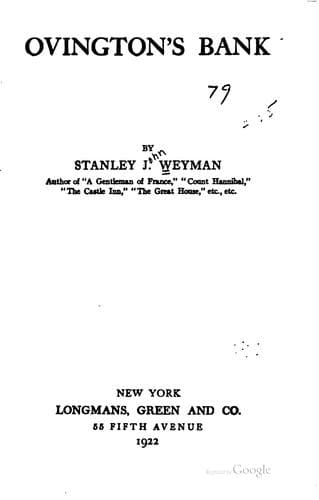
Banks and banking -- Fiction; England -- Social life and customs -- 19th century -- Fiction; Love stories
“Just put this to the Hobdays’ account,” the lawyer answered recalled
to his business. “Fifty-four pounds two shillings and five-pence. And,
by the way, are you going to Garth on Saturday?”
“On Saturday, or Sunday, yes. Can I do anything for you!”
“Will you tell the Squire that that lease will be ready for signature
on Saturday week. If you don’t mind I’ll send it over by you. It will
save me a journey.”
“Good. I’ll tell him. He has been fretting about it. Good-day! Now, Mr.
Brownjohn?”
“I’d like cash for these,” the innkeeper mumbled, thrusting forward the
notes, but looking thoroughly ill at ease.
“Man alive, why didn’t you say so?” Arthur answered, good-humoredly,
“and save yourself the trouble of two journeys? Mr. Rodd, cash for
these, please. I’ve forgotten something I must tell Welsh!” And
flinging the cash drawer wide open, he raised the counter-flap and
hurried after the lawyer.
Rodd knew what was expected of him, and he took out several fistsful of
gold and rattled it down before him. Rapidly, as if he handled so many
peas, he counted out and thrust aside Mr. Brownjohn’s portion, swiftly
reckoned it a second time, then swept the balance back into the open
drawer. “I think you’ll find that right,” he said. “Better count it.
How’s your little girl that was ailing, Mr. Brownjohn?”
Brownjohn muttered something, his face lighting up. Then he counted his
gold and sneaked out, impressed, as Arthur had intended he should be,
with his own unimportance, and more inclined than before to think that
he had made a mistake in following Wolley’s advice.
But before the bank closed that day two other customers came in and
drew out the greater part of their balances. They were both men
connected in one way or another with the clothier, and the thing
stopped there. The following day was uneventful, but the drawings had
been unusual, and the two young clerks might have exchanged notes upon
the subject if their elders had not appeared so entirely unconscious.
As it was, it was impossible for them to think that anything out of the
common had happened.
Public-domain text, read in full here on John Shaqi.
Reviews
Reviews
No reviews yet
Be the first to share your thoughts on this work.
Elsewhere in the archive
Join the Discussion
Join the discussion
Sign in to leave a comment or review.
Sign InorCreate an account