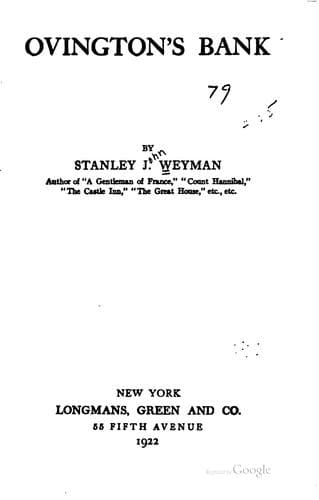
Banks and banking -- Fiction; England -- Social life and customs -- 19th century -- Fiction; Love stories
“A partnership! Nothing definite, nothing to bind, and not yet, but in
the future. It was but a hint. But think of it, mother! It is what I
have been aiming at all along, but I didn’t expect to hear of it yet.
Not one or two hundred a year, but say, five hundred to begin with, and
three, four, five thousand by and by! Five thousand!” His eyes sparkled
and he threw back the hair from his forehead with a characteristic
gesture. “Five thousand a year! Think of that and don’t talk to me of
Orders. Take Orders! Be a beggarly parson while I have that in my
power, and in my power while I am still young! For trust me, with
Ovington at the helm and the tide at flood we shall move. We shall
move, mother! The money is there, lying there, lying everywhere to be
picked up. And we shall pick it up.”
“You take my breath away!” his mother protested, her faded, delicate
face unusually flushed. “Five thousand a year! Gracious me! Why, it is
more than your uncle has!” She raised her mittened hands in protest.
“Oh, it is impossible!” The vision overcame her.
But “It is perfectly possible,” he repeated. “Clement is of no use. He
is for ever wanting to be out of doors—a farmer spoiled. Rodd’s a mere
mechanic. Ovington cannot do it all, and he sees it. He must have
someone he can trust. And then it is not only that I suit him. I am
what he is not—a gentleman.”
“If you could have it without going to the bank!” Mrs. Bourdillon said.
And she sighed, golden as was the vision. But before they parted his
eloquence had almost persuaded her. She had heard such things, had
listened to such hopes, had been dazzled by such sums that she was
well-nigh reconciled even to that which the old Squire dubbed “the
trade of usury.”
CHAPTER III
Meanwhile Clement Ovington jogged homeward through the darkness, his
thoughts divided between the discussion at which he had made an
unwilling third, and the objects about him which were never without
interest for this young man. He had an ear, and a very sharp one, for
the piping of the pee-wits in the low land by the river, and the owl’s
cadenced cry in the trees about Garth. He marked the stars shining in a
depth of heaven opened amid the flying wrack of clouds; he picked out
Jupiter sailing with supreme dominion, and the Dog-star travelling
across the southern tract. His eye caught the gleam of water on a
meadow, and he reflected that old Gregory would never do any good with
that ground until he made some stone drains in it. Not a sound in the
sleeping woods, not the barking of a dog at a lonely homestead—and he
knew every farm by name and sight and quality—escaped him; nor the
shape of a covert, blurred though it was and leafless. But amid all
these interests, and more than once, his thoughts as he rode turned
inwards, and he pictured the face of the girl at the ball. Long
forgotten, it recurred to him with strange persistence.
Public-domain text, read in full here on John Shaqi.
Reviews
Reviews
No reviews yet
Be the first to share your thoughts on this work.
Join the Discussion
Join the discussion
Sign in to leave a comment or review.
Sign InorCreate an account