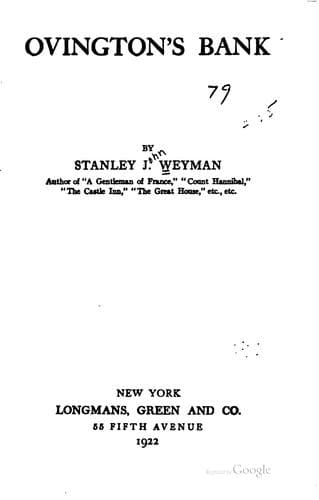
Banks and banking -- Fiction; England -- Social life and customs -- 19th century -- Fiction; Love stories
He was narrow, choleric, proud, miserly; he had been known to carry an
old log a hundred yards to add it to his wood-pile, and to travel a
league to look for a lost sixpence. He dressed shabbily, which was not
so much remarked now that dandies aped coachmen, as it had been in his
younger days; and he rode about his fields on an old white mare which
he was believed to hold in affection next after his estate and much
before his daughter. He ruled his parish with a high hand. He had no
mercy for poachers. But he was honest and he was just. The farmers must
pay the wage he laid down—it was a shilling above the allowed rate. But
the men must work it out, and woe betide the idle; they had best seek
work abroad, and heaven help them if a foreign parish sent them home.
In one thing he was before his time; he was resolved that no
able-bodied man should share in the rates. The farmers growled, the
laborers grumbled, there were hard cases. But he was obdurate—work your
worth, or starve! And presently it began to be noticed that the parish
was better off than its neighbors. He was a tyrant, but a just tyrant.
Such was the man whom Ovington was going to meet, and from whose
avarice he hoped much. He had made his market of it once, for it was by
playing on it that he had lured the Squire from Dean’s, and so had
gained one of his dearest triumphs over the old Aldersbury Bank.
His hopes would not have been lessened had he heard a dialogue which
was at that moment proceeding in the stable-yard at Garth to an
accompaniment of clattering pails and swishing besoms. “He’ve no
bowels!” Thomas the groom declared with bitterness. “He be that hard
and grasping he’ve no bowels for nobody!”
Old Fewtrell, the Squire’s ancient bailiff, sniggered. “He’d none for
you, Thomas,” he said, “when you come back gallus drunk from Baschurch
Fair. None of your Manchester tricks with me, says Squire, and, lord,
how he did leather ’ee.”
Thomas did not like the reminiscence. “What other be I saying!” he
snarled. “He’ve no bowels even for his own flesh and blood! Did’ee ever
watch him in church? Well, where be he a-looking? At his son’s moniment
as is at his elbow? Never see him, never see him, not once!”
“Well, I dunno as I ’ave, either,” Fewtrell admitted.
“No, his eyes is allus on t’other side, a-counting up the Griffins
before him, and filling himself up wi’ pride.”
“Dunno as I couldn’t see it another way,” said the bailiff
thoughtfully.
“What other way? Never to look at his own son’s moniment?”
“Well, mebbe——”
“Mebbe?” Thomas cried with scorn. “Look at his darter! He ain’t but
one, and he be swilling o’ money! Do he make much of her, James
Fewtrell? And titivate her, and pull her ears bytimes same as you with
your grand-darters? And get her a horse as you might call a horse? You
know he don’t. If she’s not quick, it’s a nod and be damned, same as to
you and me!”
Old Fewtrell considered. “Not right out the same,” he decided.
Public-domain text, read in full here on John Shaqi.
Reviews
Reviews
No reviews yet
Be the first to share your thoughts on this work.
Join the Discussion
Join the discussion
Sign in to leave a comment or review.
Sign InorCreate an account