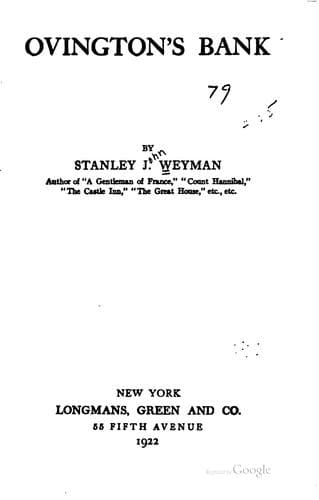
Banks and banking -- Fiction; England -- Social life and customs -- 19th century -- Fiction; Love stories
“Right out, I say. You’ve been with him all your life. You’ve never
knowed no other and you’re getting old, and Calamity, he be old too,
and may put up with it. But I don’t starve for no Squire, and I’m for
more wage. I was in Aldersbury Saturday and wages is up and more work
than men! While here I’m a-toiling for what you got twenty year ago.
But not me! I bin to Manchester. And so I’m going to tell Squire.”
The bailiff grinned. “Mebbe he’ll take a stick same as before.”
“He’d best not!” Thomas said, with an ugly look. “He’d best take care,
or——”
“Whist! Whist! lad. You be playing for trouble. Here be Squire.”
The Squire glared at them, but he did not stop. He stalked into the
house and, passing through it, went out by the front door. He intended
to turn right-handed, and enter the high-terraced garden facing south,
in which he was wont to take, even in winter, a few turns of a morning.
But something caught his eye, and he paused. “Who’s this?” he muttered,
and shading his eyes made out a moment later that the stranger was
Ovington. A visit from him was rare enough to be a portent, and the
figure of his bank balance passed through the Squire’s mind. Had he
been rash? Ovington’s was a new concern; was anything wrong? Then
another idea, hardly more welcome, occurred to him: had the banker come
on his nephew’s account?
If so—however, he would soon know, for the visitor was by this time
half-way up the winding drive, sunk between high banks, which, leaving
the road a third of a mile from the house, presently forked, the left
branch swerving through a grove of beech trees to the front entrance,
the right making straight for the stables.
The Squire met his visitor at the gate and, raising his voice, shouted
for Thomas. “I am sorry to trespass on you so early,” Ovington said as
he dismounted. “A little matter of business, Mr. Griffin, if I may
trouble you.”
The old man did not say that it was no trespass, but he stood aside
punctiliously for the other to precede him through the gate. Then,
“You’ll stay to eat something after your ride?” he said.
“No, I thank you. I must be in town by noon.”
“A glass of Madeira?”
“Nothing, Squire, I thank you. My business will not take long.”
By this time they stood in the room in which the Squire lived and did
his business. He pointed courteously to a chair. He was shabby, in
well-worn homespun and gaiters, and the room was shabby, walled with
bound Quarterlies and old farm books, and littered with spurs and dog
leashes—its main window looked into the stable yard. But there was
about the man a dignity implied rather than expressed, which the spruce
banker in his shining Hessians owned and envied. The Squire could look
at men so that they grew uneasy under his eye, and for a moment, owning
his domination, the visitor doubted of success. But then again the room
was so shabby. He took heart of grace.
Public-domain text, read in full here on John Shaqi.
Reviews
Reviews
No reviews yet
Be the first to share your thoughts on this work.
Join the Discussion
Join the discussion
Sign in to leave a comment or review.
Sign InorCreate an account