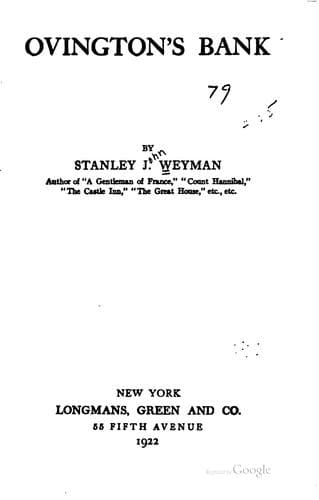
Banks and banking -- Fiction; England -- Social life and customs -- 19th century -- Fiction; Love stories
“Oh!” The banker looked grave. “You are thinking of the Railroad,
Purslow?”
“To be sure! What else?—excuse me, sir! And what I say is, if Grounds,
why not me? I’ve been mayor twice and him not even on the Council? And
I’m not a pauper, as none knows better than you, Mr. Ovington. If it’s
only that I’m a tradesman, why, there ought to be a tradesman on it,
and I’ll be bound as many will follow my lead as Grounds’.”
The banker seemed to consider. “Look here, Purslow,” he said, “you are
doing very well, not a man in Aldersbury better. Take my advice and
stick to the shop.”
“And slave for every penny I make!”
“Slow and sure is a good rule.”
“Oh, damn slow and sure!” cried the draper, forgetting his manners. “No
offence, sir, I’m sure. Excuse me. But slow and sure, while Grounds is
paid for every time he crosses the street, and doubles his money while
he wears out his breeches!”
“Well,” said Ovington, with apparent reluctance, “I’ll think it over.
But to sit on the Board means putting in money, Purslow. You know that,
of course.”
“And haven’t I the money?” the man cried, inflamed by opposition.
“Can’t I put down penny for penny with Grounds? Ay, though I’ve served
the town twice, and him not even on the Council!”
“Well, I’ll bear it in mind. I can say no more than that,” Ovington
rejoined. “I must consult Sir Charles. It’s a responsible position,
Purslow. And, of course, where there are large profits, as we hope
there may be, there must be risk. There must be some risk. Don’t forget
that. Still,” touching up his horse with his heel, “I’ll see what I can
do.”
He gained the bank without further stay, and there the stir and bustle
which his practised eye was quick to mark sustained the note already
struck. There were customers coming and going: some paying in, others
seeking to have bills renewed, or a loan on securities that they might
pay calls, or accommodation of one kind or another. But with easy money
these demands could be granted, and many a parcel of Ovington’s notes
passed out amid smiling and general content. The January sun was
shining as if March winds would never blow, and credit seemed to be a
thing to be had for the asking.
It was only within the last seven years that Ovington’s had ventured on
an issue of notes. Then, a little before the resumption of cash
payments, they had put them forth with a tentative, “If you had rather
have bank paper it’s here.” Some had had the bad taste to prefer the
Abraham Newlands, a few had even asked for Dean’s notes. But borrowers
cannot be choosers, the notes had gradually got abroad, and though at
first they had returned with the rapidity of a homing pigeon, the
readiness with which they were cashed wrought its effect, and by this
time the public were accustomed to them.
Dean’s notes bore a big D, and Ovington’s, for the benefit of those who
could not read, were stamped with a large CO., for Charles Ovington.
Public-domain text, read in full here on John Shaqi.
Reviews
Reviews
No reviews yet
Be the first to share your thoughts on this work.
Join the Discussion
Join the discussion
Sign in to leave a comment or review.
Sign InorCreate an account