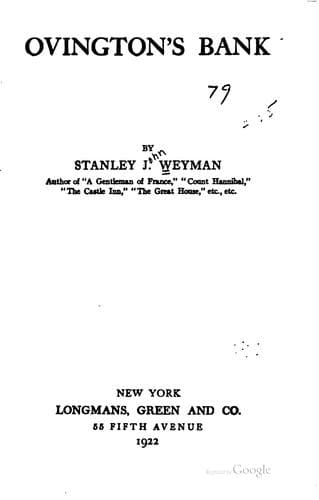
Banks and banking -- Fiction; England -- Social life and customs -- 19th century -- Fiction; Love stories
Alone with his daughter that evening the banker referred to this.
“Betty,” he said, after a long silence, “I am going to make a change. I
am going to turn CO. into Company.”
She understood him at once, and “Oh, father!” she cried, laying down
her work. “Who is it? Is it Arthur?”
“Would you like that?”
She replied by another question. “Is he really so clever?”
“He’s a gentleman—that’s much. And a Griffin, and that’s more, in a
place like this. And he’s—yes, he’s certainly clever.”
“Cleverer than Mr. Rodd?”
“Rodd! Pooh! Arthur’s worth two of him.”
“Quite the industrious apprentice!” she murmured, her hands in her lap.
“Well, you know,” lightly, “what happened to the industrious
apprentice, Betty?”
She colored. “He married his master’s daughter, didn’t he? But there
are two words to that, father. Quite two words.”
“Well, I am going to offer him a small share. Anything more will depend
upon himself—and Clement.”
She sighed. “Poor Clement!”
“Poor Clement!” The banker repeated her words pettishly. “Not poor
Clement, but idle Clement! Can you do nothing with that boy? Put no
sense into him? He’s good for nothing in the world except to moon about
with a gun. Last night he began to talk to me about Cobbett and some
new wheat. New wheat, indeed! Rubbish!”
“But I think,” timidly, “that he does understand about those things,
father.”
“And what good will they do him? I wish he understood a little more
about banking! Why, even Rodd is worth two of him. He’s not in the bank
four days in the week. Where is he to-day?”
“I am afraid that he took his gun—but it was the last day of the
season. He said that he would not be out again. He has been really
better lately.”
“Though I was away!” the banker exclaimed. And he said some strong
things upon the subject, to which Betty had to listen.
However, he had recovered his temper when he sent for Arthur next day.
He bade him close the door. “I want to speak to you,” he said; then he
paused a moment while Arthur waited, his color rising. “It’s about
yourself. When you came to me I did not expect much from the
experiment. I thought that you would soon tire of it, being what you
are. But you have stood to it, and you have shown a considerable
aptitude for the business. And I have made up my mind to take you in—on
conditions, of course.”
Arthur’s eyes sparkled. He had not hoped that the offer would be made
so soon, and, much moved, he tried to express his thanks. “You may be
sure that I shall do my best, sir,” he said.
“I believe you will, lad. I believe you will. Indeed, I am thinking of
myself as well as of you. I had not intended to make the offer so
soon—you are young and could wait. But you will have to bring in a
certain sum, and capital can be used at present to great advantage.”
Arthur looked grave. “I am afraid, sir——”
Public-domain text, read in full here on John Shaqi.
Reviews
Reviews
No reviews yet
Be the first to share your thoughts on this work.
Join the Discussion
Join the discussion
Sign in to leave a comment or review.
Sign InorCreate an account