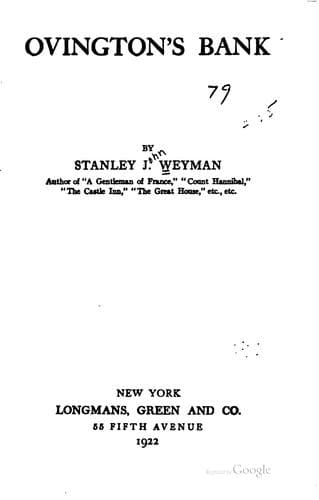
Banks and banking -- Fiction; England -- Social life and customs -- 19th century -- Fiction; Love stories
The terraced garden at Garth rested to the south and east on a
sustaining wall so high that to build it to-day would tax the resources
of three Squires. Unfortunately, either for defence or protection from
the weather, the wall rose high on the inner side also, so that he who
walked in the garden might enjoy the mellow tints of the old brickwork,
but had no view of the country except through certain loop-holes,
gable-shaped, which pierced the wall at intervals, like the port-holes
of a battleship. If the lover of landscape wanted more, he must climb
half a dozen steps to a raised walk which ran along the south side.
Thence he could look, as from an eyrie, on the green meadows below him,
or away to the line of hills to westward, or turning about he could
overlook the operations of the gardener at his feet.
More, if it rained or blew there was at the south-west corner, and
entered from the raised walk, an ancient Dutch summer-house of brick,
with a pyramidal roof. It had large windows and, with much at Garth
that served for ornament rather than utility, it was decayed, time and
damp having almost effaced its dim frescoes. But tradition hallowed it,
for it was said that William of Orange, after dining in the hall at the
oaken table which still bore the date 1691, had smoked his pipe and
drunk his Schnapps in this summer-house; and thence had watched the
roll of the bowls and the play of the bias on the turf below. For in
those days the garden had been a bowling green.
There on summer evenings the Squire would still drink his port, but in
winter the place was little used, tools desecrated it, and tubers took
refuge in it. So when Josina began about this time to frequent it, and,
as winter yielded to the first breath of spring, began to carry her
work thither of an afternoon, Miss Peacock should have had her
suspicions. But the good lady saw nothing, being a busy woman. Thomas
the groom did remark the fact, for idle hands make watchful eyes, but
for a time he was none the wiser.
“What’s young Miss doing up there?” he asked himself. “Must be
tarnation cold! And her look’s fine, too! Ay, ’tis well to be them as
has nought to do but traipse up and down and sniff the air!”
Naturally it did not at once occur to him that the summer-house
commanded a view of the path which ran along the brook side; nor did he
suppose that Miss had any purpose, when, as might happen perhaps once a
week, she would leave her station at the window and in an aimless
fashion wander down to the mill—and beyond it. She might be following a
duck inclined to sit, or later—for turkeys will stray—be searching for
a turkey’s nest. She might be doing fifty things, indeed—she was
sometimes so long away. But the time did come when, being by chance at
the mill, Thomas saw a second figure on the path beside the water, and
he laid by the knowledge for future use. He was a sly fellow, not much
in favor with the other servants.
Public-domain text, read in full here on John Shaqi.
Reviews
Reviews
No reviews yet
Be the first to share your thoughts on this work.
Join the Discussion
Join the discussion
Sign in to leave a comment or review.
Sign InorCreate an account