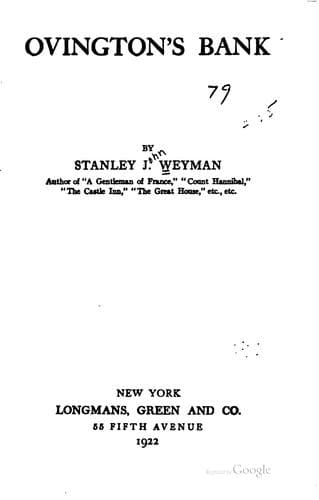
Banks and banking -- Fiction; England -- Social life and customs -- 19th century -- Fiction; Love stories
Presently there came a cold Saturday in March, a wet, windy day, when
to saunter by the brook would have too odd an air. But would it have an
odd look, Josina wondered, standing before the glass in her room, if
she ran across to the Cottage for ten minutes about sunset? The bank
closed early on Saturdays, and men were not subject to the weather as
women were. Twice she put on her bonnet, and twice she took it off and
put it back in its box—she could not make up her mind. He might think
that she followed him. He might think her bold. Or suppose that when
they met before others, she blushed; or that they thought the meeting
strange? And, after all, he might not be there—he was no favorite with
Mrs. Bourdillon, and his heart might fail him. In the end the bonnet
was put away, but it is to be feared that that evening Jos was a little
snappish with Miss Peacock when arraigned for some act of
forgetfulness.
Had she gone she might have come off no better than Clement, who,
braving all things, did go. Mrs. Bourdillon did not, indeed, say when
he entered, “What, here again?” but her manner spoke for her, and
Arthur, who had arrived before his time, received the visitor with less
than his usual good humor. Clement’s explanation, that he had left his
gun, fell flat, and so chilly were the two that he stayed but twenty
minutes, then faltered an excuse, and went off with his tail between
his legs.
He did not guess that he had intruded on a family difference, a trouble
of some standing, which the passage of weeks had but aggravated. It
turned on Ovington’s offer, which Arthur, pluming himself on his
success and proud of his prospects, had lost no time in conveying to
his mother. He had supposed that she would see the thing with his eyes,
and be as highly delighted. To become a partner so early, to share at
his age in the rising fortunes of the house! Surely she would believe
in him now, if she had never believed in him before.
But Mrs. Bourdillon had been imbued by her husband with one fixed
idea—that whatever happened she must never touch her capital; that
under no circumstances must she spend it, or transfer it or alienate
it. That way lay ruin. No sooner, therefore, had Arthur come to that
part of his story than she had taken fright; and nothing that he had
been able to say, no assurance that he had been able to give, no gilded
future that he had been able to paint, had sufficed to move the good
woman from her position.
“Of course,” she said, looking at him piteously, for she hated to
oppose him, “I’m not saying that it does not sound nice, dear.”
“It is nice! Very nice!”
Public-domain text, read in full here on John Shaqi.
Reviews
Reviews
No reviews yet
Be the first to share your thoughts on this work.
Join the Discussion
Join the discussion
Sign in to leave a comment or review.
Sign InorCreate an account