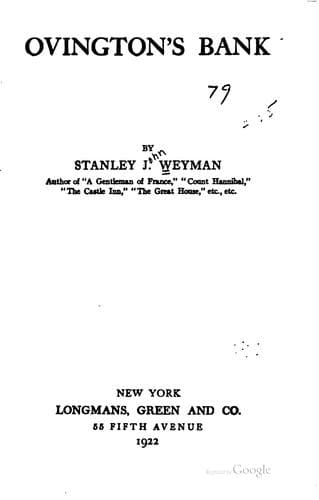
Banks and banking -- Fiction; England -- Social life and customs -- 19th century -- Fiction; Love stories
It was in the third week of April that Arthur returned to Aldersbury.
Ovington had not failed to let his correspondents know that the lad was
no common mercantile person, but came of a county family and had
connections; and Arthur had been fêted by the bank’s agents and made
much of by their friends. The negotiation which Ovington had entrusted
to him had gone well, as all things went well at this time. His
abilities had been recognized in more than one counting-house, and in
the general elation and success, civilities and hospitality had been
showered upon him. Mothers and daughters had exerted themselves to
please the nephew—it was whispered the heir—of the Aldshire magnate;
and what Arthur’s letters of credit had not gained for him, his
handsome face and good breeding had won. He came back, therefore, on
the best of terms with himself and more in love than ever with the
career which he had laid out. And, but for the money difficulty, and
his mother’s obstinacy, he would have seen all things in rose color.
He returned at the moment when speculation in Aldersbury—and Aldersbury
was in this but a gauge of the whole country—was approaching its fever
point. The four per cent, consols, which not long before had stood at
72, were 106. The three per cents., which had been 52, had risen to 93.
India stock was booming at 280, and these prices, which would have
seemed incredible to a former generation, were justified by the large
profits accruing from trade and seeking investment. They were, indeed,
nothing beside the heights to which more speculative stocks were being
hurried. Shares in one mine, bought at ten pounds, changed hands at a
hundred and fifty. Shares in another, on which seventy pounds had been
paid, were sold at thirteen hundred. An instalment of £5 was paid on
one purchase, and ten days later the stock was sold for one hundred and
forty!
Under such circumstances new ventures were daily issued to meet the
demand. Proposals for thirty companies came out in a week, and still
there appeared to be money for all, for the banks, tempted by the
prevailing prosperity, increased their issues of notes. It seemed an
easy thing to borrow at seven per cent., and lay out the money at ten
or fifteen, with certainty of a gain in capital. Men who had never
speculated saw their neighbors grow rich, and themselves risked a
hundred and doubled it, ventured two and saw themselves the possessers
of six. It was like, said one, picking up money in a hat. It was like,
said another, baling it up in a bucket. There seemed to be money
everywhere—money for all. Peers and clergymen, shop-keepers and maiden
ladies, servants even, speculated; while those who knew something of
the market, or who could allot shares in new ventures, were courted and
flattered, drawn into corners and consulted by troops of friends.
Public-domain text, read in full here on John Shaqi.
Reviews
Reviews
No reviews yet
Be the first to share your thoughts on this work.
Join the Discussion
Join the discussion
Sign in to leave a comment or review.
Sign InorCreate an account