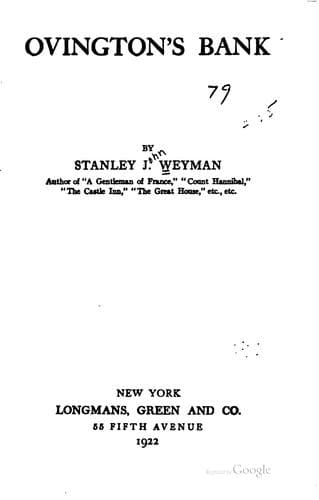
Banks and banking -- Fiction; England -- Social life and customs -- 19th century -- Fiction; Love stories
All this came to its height at the end of April, and Arthur, sanguine
and eager, laden with the latest news from Lombard Street, returned to
Aldersbury to revel in it. He trod the Cop and the High Street as if he
walked on air. He moved amid the excitement like a young god. His nod
was confidence, his smile a promise. A few months before he had
doubted. He had viewed the rising current of speculation from without,
and had had his misgivings. Now the stream had caught him, and if he
ever reflected that there might be rocks ahead, he flattered himself
that he would be among the first to take the alarm.
The confidence which he owed to youth, the banker drew from a past of
unvarying success. But the elder man did have his moments of mistrust.
There were hours when he saw hazards in front, and the days on which he
did not call for the Note Issues were few. But even he found it easier
to go with the current, and once or twice, so high was his opinion of
Arthur’s abilities, he let himself be persuaded by him. Then the mere
bustle was exhilarating. The door of the bank that never rested, the
crowded counter, the incense of the streets, the whispers where he
passed, all had their intoxicating effect. The power to put a hundred
pounds into a man’s pocket—who can abstain from, who is not flattered
by, the use of this, who can at all times close his mouth? And often
one thing leads to another, and advice is the prelude to a loan.
It was above all when the railroad scheme was to the fore that the
banker realized his importance. It was his, he had made it, and it was
on its behalf that he was disposed to put his hand out farthest. The
Board, upon Sir Charles’s proposal—the fruit of a hint dropped by
Ovington—had fixed the fourth market-day in April for the opening of
the subscription list. Though the season was late, the farmers would be
more or less at liberty; and as it happened the day turned out to be
one of the few fine days of that spring. The sun, rarely seen of late,
shone, the public curiosity was tickled, the town was full, men in the
streets quoted the tea-kettle and explained the powers of steam; and
Arthur, as he forged his way through the good-tempered, white-coated
throng, felt to the full his importance.
Near the door of the bank he met Purslow, and the draper seized his
arm. “One moment, sir, excuse me,” he whispered. “I’ve a little more I
can spare at a pinch. What do you advise, Mr. Bourdillon?”
Arthur knew that it was not in his province to advise, and he shook his
head. “You must ask Mr. Ovington,” he said.
“And he that busy that he’ll snap my nose off! And you’re just from
London. Come, Mr. Bourdillon, just for two or three hundred pounds. A
good ’un! A real good ’un! I know you know one!”
Public-domain text, read in full here on John Shaqi.
Reviews
Reviews
No reviews yet
Be the first to share your thoughts on this work.
Join the Discussion
Join the discussion
Sign in to leave a comment or review.
Sign InorCreate an account