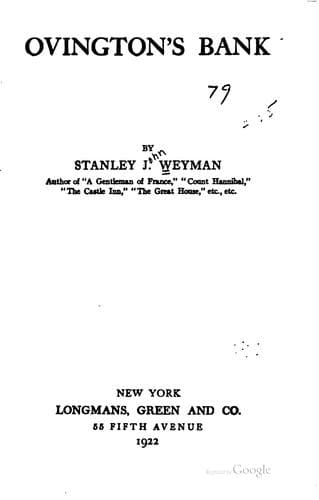
Banks and banking -- Fiction; England -- Social life and customs -- 19th century -- Fiction; Love stories
“No, we are here to act,” Ovington assented, with an eye on Grounds,
for whose benefit he had been talking. “But on sober and
well-considered lines. We are all agreed, I think, that such a railroad
will be a benefit to the trade and district?”
Now, to this proposition not one of those present would have assented a
year before. “Steam railroads?” they would have cried, “fantastic and
impossible!” But the years 1823 and 1824 had been years not only of
great prosperity but of abnormal progress. The seven lean years, the
years of depression and repression, which had followed Waterloo had
come to an end. The losses of war had been made good, and
simultaneously a more liberal spirit had been infused into the
Government. Men had breathed freely, had looked about them, had begun
to hope and to venture, to talk of a new world. Demand had overtaken
and outrun supply, large profits had been made, money had become cheap,
and, fostered by credit, the growth of enterprise throughout the
country had been marvellous. It was as if, after the frosts of winter,
the south wind had blown and sleeping life had everywhere awakened. Men
doubled their operations and still had money to spare. They put the
money in the funds—the funds rose until they paid no more than three
per cent. Dissatisfied, men sought other channels for their savings,
nor sought in vain. Joint Stock Companies arose on every side.
Projects, good and bad, sprang up like mushrooms in a night. Old lodes
and new harbors, old canals and new fisheries, were taken in hand, and
for all these there seemed to be capital. Shares rose to a premium
before the companies were floated, and soon the bounds of our shores
were found to be too narrow for British enterprise. At that moment the
separation of the South American countries from Spain fell out, and
these were at once seen to offer new outlets. The romantic were dazzled
with legends of mines of gold and pockets of diamonds, while the
gravest saw gain in pampas waving with wheat and prairies grazed by
countless herds. It was felt, even by the most cautious, that a new era
had set in. Trade, soaring on a continual rise in prices, was to know
no bounds. If the golden age of commerce had not begun, something very
like it had come to bless the British merchant.
Under such circumstances the Valleys Railroad seemed a practical thing
even to Grounds, and Ovington’s question was answered by a general
assent.
Public-domain text, read in full here on John Shaqi.
Reviews
Reviews
No reviews yet
Be the first to share your thoughts on this work.
Join the Discussion
Join the discussion
Sign in to leave a comment or review.
Sign InorCreate an account