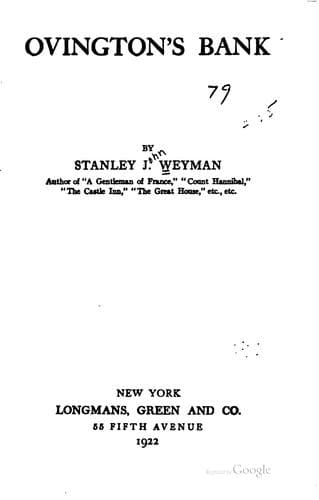
Banks and banking -- Fiction; England -- Social life and customs -- 19th century -- Fiction; Love stories
“Very good, gentlemen,” he resumed. “Then I may take that as agreed.”
He proceeded to enter upon the details of the scheme. The length of the
line would be fourteen miles. The capital was to be £45,000, divided
into 4500 shares of £10 each, £1 a share to be paid at once, the sum so
raised to be used for the preliminary expenses; £1 10s. per share to be
paid three months later, and the rest to be called up as required. The
directors’ qualification would be fifty shares. The number of directors
would be seven—the five gentlemen now present and two to be named, as
to whom he would have a word to say by-and-by. Mr. Bourdillon, of whose
abilities he thought highly—here several at the table looked kindly at
the young man—and who for other reasons was eminently fitted for the
position, would be secretary.
“But will the forty-five thousand be enough, sir?” Grounds ventured
timidly. He alone was not directly interested in the venture. Wolley
was the tenant of a large mill. Sir Charles was the owner of two mills
and the hamlets about them, Acherley of a third. Ovington had various
interests.
“To complete the line, Mr. Grounds? We believe so. To provide the
engine and coaches another fifteen thousand will be needed, but this
may be more cheaply raised by a mortgage.”
Sir Charles shied at the word. “I don’t like a mortgage, Mr. Ovington,”
he said.
“No, d——n a mortgage!” Acherley chimed in. He had had much experience
of them.
“The point is this,” the banker explained. “The road once completed, we
shall be able to raise the fifteen thousand at five per cent. If we
issue shares they must partake, equally with ourselves, in the profits,
which may be fifteen, twenty, perhaps twenty-five per cent.”
A twinkle of greed passed from eye to eye. Fifteen, twenty, twenty-five
per cent.! Ho, ho!
“The next question,” Ovington continued, “is important. We cannot use
the highway, the gradients and angles render that impossible. We must
acquire a right of way; but, fortunately, the estates we run over are
few, no more than thirteen in all, and for a full third of the distance
they are represented at this table.” He bowed gracefully to the two
landowners. “Sir Charles will, of course, be President of the Road and
Chairman of the Directors. We are fortunate in having at our head a
country gentleman who has”—he bowed again—“the enlightenment to see
that the landed interest is best served by making commerce contributory
to its well-being.”
“But what about the game?” Sir Charles asked anxiously. “You don’t
think——”
“On that point the greatest care will be taken. We shall see that no
covert is closely approached.”
“And the—you won’t bring the line within sight of——”
“Of the Park? God forbid! The amenities of every estate must be
carefully guarded. And, of course, a fair price for the right of way
will be agreed. Seven of the smaller landowners I have sounded, and we
shall have no trouble with them. The largest estate outstanding——”
Public-domain text, read in full here on John Shaqi.
Reviews
Reviews
No reviews yet
Be the first to share your thoughts on this work.
Join the Discussion
Join the discussion
Sign in to leave a comment or review.
Sign InorCreate an account