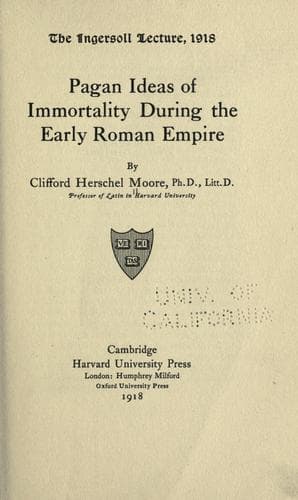
Pagan Ideas of Immortality During the Early Roman EmpireMoore, Clifford Herschel
Religion
Pagan Ideas of Immortality During the Early Roman Empire
Moore, Clifford Herschel
Immortality; Rome -- Religion
But no doctrine of the post-corporeal existence of the soul has ever had
the field entirely to itself. We know that in antiquity even the Stoic
conception of the soul’s limited survival, to say nothing of Platonic
beliefs in actual immortality, met with much opposition and denial among
the intellectual classes. The Epicureans, with their thorough-going
atomistic materialism, would not allow that the soul had any existence
apart from the body; on the contrary, they held that the soul came into
being at the moment of conception, grew with the body, and, at the
body’s death, was once more dissolved into the atoms from which it
first was formed. Epicurean polemics were directed against both popular
superstitions and Platonic metaphysics; the attacks had the advantage of
offering rational, and for the day scientific, explanations of natural
phenomena, which fed human curiosity as to the causes of things, and
which, if accepted, might logically lead to that freedom from the soul’s
perturbation which was the aim of the teaching. Moreover, the noble
resignation, the high moral and humane zeal, which characterized the
Epicurean School at its best, as well as its easy decline into
hedonistic appeals, made it popular, especially in the last two
centuries before our era. But the very fire and passion of Lucretius,
its most gifted Latin exponent, give us the impression that after all
most men were not moved to find the peace which the poet promised them,
if they would but accept the doctrine of the soul’s dissolution at the
moment of death.
The Sceptics also, who claimed not an inconsiderable number of
intellectuals, doubted the possibility of a future life, or found
themselves unable to decide the matter at all. Like Tennyson’s Sage they
would declare:
“Thou canst not prove that thou art body alone,
Nor canst thou prove that thou art spirit alone,
Nor canst thou prove that thou art both in one:
Thou canst not prove that thou art immortal, no,
Nor yet that thou art mortal.”
Indeed it is true that of all the philosophic sects at the beginning of
our era, only those which were imbued with Platonic and
Orphic-Pythagorean ideas, had confidence in the soul’s immortality. The
Stoic position we have already discussed. Some scholars, following
Rohde,[16] claim that there was little belief in any kind of a future
life among the educated classes at the time we are considering; this I
hold to be an error, although it is certain that the Epicureans and
Sceptics had a large following. In any case we need to remind ourselves
that the intellectuals are always a small minority, whose views may not
represent in any way popular beliefs.
Public-domain text, read in full here on John Shaqi.
Reviews
Reviews
No reviews yet
Be the first to share your thoughts on this work.
Join the Discussion
Join the discussion
Sign in to leave a comment or review.
Sign InorCreate an account