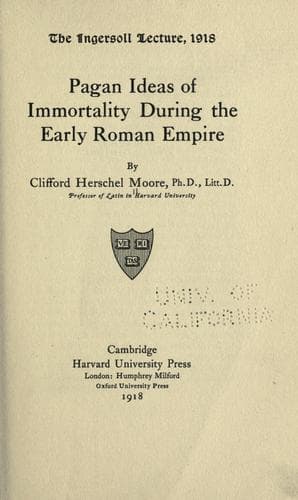
Pagan Ideas of Immortality During the Early Roman EmpireMoore, Clifford Herschel
Religion
Pagan Ideas of Immortality During the Early Roman Empire
Moore, Clifford Herschel
Immortality; Rome -- Religion
Although Plato and his greatest pupil, Aristotle, regarded man’s
reasoning soul as spiritual, something distinct from matter, few ancient
thinkers were able to rise to the concept of the immateriality of man’s
reasoning nature. The Stoics, who in their eclectic system borrowed from
both Plato and Aristotle, as well as from many other predecessors, held
to a strict materialism which they took from Heraclitus. But to their
material principle they applied a concept which they took from
Aristotle, for they recognized in all things the existence of an active
and a passive principle, and they said that by the action of the former
on the latter, all phenomena were produced. The active principle they
called reason, intelligence, the cause of all things. It was the
world-reason which, according to their view, permeated every part of
the cosmos, causing and directing all things. To express their concept
of its nature, they often named it Fire, the most powerful and active of
the elements, or rather the primordial element; again they often called
it God, for they did not hesitate to speak of this immanent principle as
a person. Furthermore, since man is a part of the cosmos, the
world-reason expresses itself in him. Indeed man’s reason, the directing
element of the human soul, is itself a part of the world-reason, or in
Epictetus’ striking phrase, man is “a fragment of God.”[14] At this
point the Stoic and the Platonist were in accord, although the paths of
thought which they had travelled were very different. Yet the Stoic
could not agree with the Platonist that the individual soul survived
forever, since he held to a cyclical theory of the cosmos, according to
which this present universe was temporal. It had been created by the
eternal fire, by the world-reason, from itself, and it was destined in
due season to sink back again into universal fire. Meantime, according
to the views of most Stoics, the souls of the just would survive this
body, ascending to the spheres above the world, where they would dwell
until absorbed once more into the divine element from which they sprang.
To the souls of the wicked only a short period at most of post-corporeal
existence was granted--brevity of life or annihilation was their
punishment.[15]
Strictly speaking, the prospect of the limited existence after death,
which the Stoics held out as virtue’s reward, should have had little
value for the philosophic mind, especially as their philosophy offered
no warrant that personality would survive at all. But it would seem that
men at every period of human history have had immortal longings in them
so strong that they have eagerly embraced the assurance of even a brief
respite from annihilation; certain it is that to many Greeks and Romans
the Stoic doctrine of a limited existence after death was a strong
incentive to virtue and a consolation in the midst of this world’s
trials.
Public-domain text, read in full here on John Shaqi.
Reviews
Reviews
No reviews yet
Be the first to share your thoughts on this work.
Join the Discussion
Join the discussion
Sign in to leave a comment or review.
Sign InorCreate an account