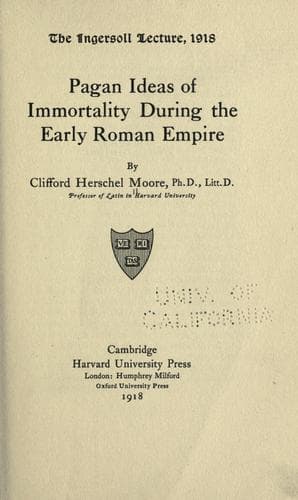
Pagan Ideas of Immortality During the Early Roman Empire — John Shaqi
Pagan Ideas of Immortality During the Early Roman EmpireMoore, Clifford Herschel
Religion
Pagan Ideas of Immortality During the Early Roman Empire
Moore, Clifford Herschel
Immortality; Rome -- Religion
But Virgil’s sixth book contains much more than the eschatological views
of philosophic schools; it reflects to an extraordinary degree popular
ideas and practices. I have already referred to the fact that it
represents a mystic initiation of Virgil’s hero as preparation for his
holy task. Now we know that at all times the convictions of the majority
of men are founded not on the arguments which thinkers can supply, but
on hopes, intuitions, and emotional experiences. Such were the grounds
on which the Orphic built his hope of the purified soul’s ultimate
happiness. More popular than Orphism were the Greek mysteries, of which
the most important were those celebrated annually at Eleusis in Attica.
There the story of the rape of Proserpina, of Demeter’s search for her
daughter, and of the daughter’s recovery, formed the center of a mystic
ceremonial. Originally these mysteries were no doubt agricultural rites
intended to call to life the dead grain in the spring. But before the
seventh century, B.C., the festival had been transformed; the miracle of
the reviving vegetation, of the grain which dies and lives again, here,
as so many times elsewhere, had become the symbol and assurance of human
immortality.[23]
Before admission to the annual celebration the would-be initiate was
duly purified. During the celebration the initiated, by their own acts,
recalled Demeter’s hunt for her daughter, roaming the shore with
lighted torches; like the goddess, they fasted and then broke their fast
by drinking a holy potion of meal and water; in the great hall of
initiation they witnessed a mystic drama, perhaps saw holy objects
exhibited and explained. In any case they underwent an emotional
experience which so confirmed their intuitional belief in immortality,
that they were confident of peace and happiness in this life and of
blessedness in the life to come, where they would join in the sacred
dance, while the uninitiated would be wretched. Many are the expressions
of this ecclesiastical confidence. The Homeric hymn of Demeter promised:
“Blessed is he among mortal men who has seen these rites.”[24] Pindar,
early in the fifth century, wrote: “Happy he who has seen these things
and then goes beneath the earth, for he knows the end of life and its
Zeus-given beginning.”[25] Sophocles said: “Thrice blessed are they who
have seen these rites, and then go to the house of Hades, for they alone
have life there, but all others have only woe.”[26] At the close of the
fifth century Aristophanes made his chorus of mystae sing: “For we alone
have a sun and a holy light, we who have been initiated, and who live
honorably toward friends and strangers, reverencing the gods.”[27] In
the third century of the Christian era, an official of the mysteries set
up an inscription which declares: “Verily glorious is that mystery
vouchsafed by the blessed gods, for death is no ill for mortals, but
rather a good.”[28]
Public-domain text, read in full here on John Shaqi.
Reviews
Reviews
No reviews yet
Be the first to share your thoughts on this work.
Join the Discussion
Join the discussion
Sign in to leave a comment or review.
Sign InorCreate an account